The Other War with Iran. Chapter 12, The Second Accident

Because of my inability to convince Mr. Shababian to help start a war, I was no longer considered the guru of all problem solutions. So when I balked when they told that three separate crews had gone to Kermanshah and found the parabolic microwave dishes properly aligned, no one wanted to listen. So I balked louder. I contacted Richard Laine, an old friend from my first job at Lenkurt Electric, a telecom manufacturer in California. As the world’s most prominent expert on microwave radio transmission, he assured me that dish alignment was the most common of all problems. It was like having two 10-feet in diameter flashlights with tiny bulbs 30 miles apart. Each one would have to be pointed exactly at the other to get the maximum power; the slightest bit of misalignment would reduce the signal strength.

After giving me a list of other less common possibilities, he analyzed the specifications of this particular path and gave me a hint that wouldn’t normally appear on other systems. After I tried to explain the hint to the test engineers at Page, they decided to send me to supervise another re-alignment instead of admitting that they had no idea what Mr. Laine was talking about.

I headed off to Kermanshah alone because Felicity had gone to Australia to visit her mother whom she hadn’t seen in four years. Without Felicity, I didn’t need to use the excuse of the dangers-of-driving-at-night to work only in the mornings at Kermanshah. I could work a full day. So I drove straight through from Tehran and arrived at the 200-foot microwave tower in the early afternoon. I found a tower maintenance crew working, but the supervisor, an Englishman, told that he and the three Iranians with him weren’t the crew that would help me align the dish. Because he had no idea when they would arrive, I decided to take an adventurous trip up the tower to the 10-foot dish mounted at the 180-foot level and give it a tweak. I had the meter that I needed to measure the signal and the two adjustable wrenches to move the antenna. But I should use safety belt. I asked the Englishman if he could loan me one, but all of his were in use. He could only loan me a belt with a pouch large enough to hold my equipment. I should have waited, but sometimes I can be a stubborn cuss, especially when a little extra adventure is at stake.

So I started climbing up the ladder mounted in the center of the tower, with what little equipment I had. Once I reached the dish, I realized I was in a place I definitely should not be. I had little experience at that height and, without a belt to support me, needed three hands: one to cling to the tower with a death grip and two to make the adjustments. Yes, the view was superb and the rush was well worth the climb. But I should’ve gone back down with the excuse that I’d only gone up to take a look. But the tools would be a giveaway, so my pride massaged my stubbornness and told me I had to at least try, even though my hands were trembling. So as I was fumbling around with the tools and meter like a drunken monkey, I felt a pressure at the small of my back.

Surprised, I looked around to see the beaming, toothy smile of one of the Iranian tower workers who’d grabbed hold of my belt to keep me from falling. At first I was unsure of his intention, so I put some of my weight against his grip while looking at him and still holding on to the tower. His penetrating dark eyes and firm smile assured me he knew I was scared and embarrassed, but he would be a true friend and keep me safe, even from myself. Seeing his other hand firmly gripping the tower, I leaned out and let go with both hands. He held and nodded his reliability and loyalty. He would be my human safety belt. As I started adjusting the antenna, I realized that if he let go, I would be dead. But the synergy  confirmed that my trust in him was warranted. So I kept on working.

The antenna had threaded rods to make the adjustments, and I only had to move it a small amount to see if the signal level on the meter would increase. I moved it left first and the level dropped a noticeable amount. Then I moved it back to the right and the meter arose back to where it was, then moved down again as I went past the position where it had originally been. I moved it back to the peak and tightened it down. I pantomimed to my protector that I needed to do the same to the vertical adjustment and he nodded his understanding. After finishing, I offered him a firm handshake with several animated nods of thanks. Then my new friend went back to the task he’d left.

I got back to the ground just as the Page electronic supervisor who I’ll again call Dick arrived at the site. He wore mirrored sunglasses and a ball cap perched back on his head, a plaid short-sleeved sport shirt, clean pressed Levis and loafers with a good shine; a slender fellow about five foot nine, slightly taller than me but a year of so younger. He knew the Englishman and his crew and, after a bit of small talk about the tasks at hand, I mentioned that one of the Iranians had helped me do the preliminary adjustment of the dish and a reward was in order. We all agreed that it was “beer-thirty,” a term used for “quitting time” by many high-risk workers; and the first shout would be on me. We headed for a bar-and-restaurant next door to the lower-priced hotel where the tower workers were staying, and soon were learning different ways to order “another round” in each others’ language. In a short while, the table and the six jovial revelers were full of beer. As the lights dimmed, the tower crew staggered to their rooms and Dick and I went to the Kermanshah motel in his air-conditioned, luxury Land Rover, the first of its sort that I’d seen on the project.

After a phone call the next morning, Dick told me our antenna alignment crew would not arrive for two more days, giving us plenty of time to do the preliminary checks that Mr. Laine had suggested. After looking at the list, Dick told me that all the previous teams had done everything on it, but since they were named Curly, Moe and Larry, we’d be better off to do them again. I then told him about Mr. Laine’s hint and he agreed that it may be the solution, but we should wait till the tower crew arrived to do it. He thought it inappropriate for an engineer to be on the tower working. Besides, we could use the two days before they arrived to do the other tests comfortably. Dick was not a dick when it came to planning troubleshooting procedures and drinking beer with a tower crew.

The next morning, Dick did another excellent job of planning the activities. We would shop for some groceries for lunch, and then go to the Earth station to finish the checks on that radio by 11:00 am. Then we could take the scenic and adventurous drive to the mountain top site and have a relaxed picnic lunch enjoying the cooler climate and view before doing the tests. We should finish by 5:00, giving us plenty of time to get back to the motel for dinner. We completed the day as planned without incident.

Author’s note: As I just found out my good friend and associate, Richard (Dick) Laine had died, I must clarify my use of “Dick” and “dick.” “Dick” is a man’s name, usually short for Richard. My name is Richard, and sometimes people call me “Dick” when their rush to familiarity supersedes their actual interest in my well-being: tactics often used by used-car salesmen, insurance and real estate agents, investment brokers, pick pockets, prostitutes and other shady characters. But I never use “Dick” as a nickname. I used “Rick.” Richard U. Laine, however, used “Dick,” and in his case, should always be used with the utmost respect. He was a forerunner in the development of microwave radio systems and an extraordinary man.
      The term “dick” on the other hand, means a male who doesn’t – for one reason or another – actually qualify as a “man.” Many questionable actions of the dick would give reason for using the term. I’ve sometimes been called a dick on instances both justified and not. Richard U. Laine should always be referred to as “Dick” and never as a “dick.”
      In my writings, for the sake of privacy, I often use the name “Dick” to replace the real name of a person who is a dick for the reasons I go on to explain. None of my fictitiously named “Dicks” are dicks all the time, but some of my Dicks are dicks most of the time. The present Dick is mostly not a dick and his dickness only appeared in a situation when he shouldn’t have been a dick. And the situation’s pretty grim.

While we were eating dinner in the restaurant of the hotel, Dick a local policeman approached us and struggled in broken English to tell us about a problem. He carefully enunciated each word showing absolutely no emotion at all. “Your friends… from last night… have small accident. Finish dinner… go to hospital… visit them.” As the message contained no urgency, we took out time discussing the possibilities of what may have happened. It was a small town and our antics of the night before probably started a bit of gossip. Everyone would know that there were three persons from another country in town, and that they’d been drinking beer with the Iranian construction workers who were not from that area, in a manner unlike the Iranian tradition. We assumed this would be quite juicy gossip in a town this size and would spread quickly. And because Iranian friendships are strong and permanent, the workers’ misfortune would certainly be of interest to us. So after dinner, we would go to the hospital to see them and perhaps return to that same restaurant for a nightcap. We agreed it would be only one beer, not another glug fest. But we weren’t taking into consideration the Iranian version of what to do with the bearer of bad news. You don’t kill him; you just don’t be him. Nobody tells bad news in Iran. So when we got to the hospital, it came as a shock to us that our friends were teetering on the edge of death.

They had thought it would be funny for the youngest one… the one with no driver’s license… to get as drunk as he could get and then drive the three-quarter ton four by four pickup truck as fast as it would go. A bridge that was blocked off for construction repairs had no advance warnings, so to avoid smashing into the barricade at the last second, he swerved to the left, hit a gravel pile on the shoulder and flipped the truck end over end, slamming it upside down into the dry creek bed  below the bridge. Of the three of who had been in the cab, one could not be sedated because he had the top of his head missing. All he could do was scream incoherently. The other two were also in critical condition with broken bones and internal injuries. The one who’d been in the back had an 18-inch crescent wrench lodged in his chest. Removing it could possibly kill him. After the doctor explained it all, he asked which of us was in charge. Dick said he was.

The doctor spoke perfect English as he looked directly into Dick’s eyes. “These men are dying and we don’t have the facilities here to save them. They need to get to them Tehran, but they may not survive the trip. The drive might kill them. What do you want us to do?”

Dick’s eyes widened and his chin dropped as he stuttered, “Wha… what do you mean, what do I want you to do?”

“You’re their boss, they work for you. They’re in no condition to make the decision for themselves. You have to make it for them.”

“But… but what about their families?” asked Dick.

“Yes,” explained the doctor. “Their families have been told that there’s been a small accident. They wanted to talk to them but we told them they were sleeping.”

Nor would the doctor be the bearer of bad news. “What do you want us to do? I need the decision as soon as possible.” He held his stare into Dick’s eyes.

After a long pause, Dick said, “Just a second,” then grabbed me by the arm and pulled me out of earshot. I assumed he wanted to discuss the problem, but I was wrong. He reached into his pocket and pulled out the keys to the luxury Land Rover. “Here,” he said as his trembling hand passed them to me. “This is way too fucked up for me. I’m taking a taxi to the bus terminal and getting the fuck out of here. You’re the fucking genius, you handle it.”

He was gone before I could utter a sound. I was out of breath… frozen. But I knew I had to do something. After taking a few deep breaths for composure, I returned to the doctor who had not budged. “Um… I’m actually the one in charge,” I said as I nodded to the now-closed door. “He… uh… he’s just learning.”

The doctor’s eyes softened and he spoke in a very low voice, “What do you want us to do?” His concerned expression, his well-groomed features and his professional attire gave me the impression he understood my position completely. And the synergy told me we shared the concern for the injured men equally.
“How long do you think they’ll last?” I asked.

He shook his head as he shrugged a hand in slight frustration. “I don’t know; a day or two, maybe three. There’s no way of knowing for sure.”

“Will they last the night?” I asked.

“Most likely they will,” he answered as he nodded his head firmly. “But we don’t have the equipment here to save them. Only Tehran has it, so if they stay here, they’ll surely die.” He didn’t budge as he let me mull it over.

“OK, I’ll get back to you as soon as I can.” He shook my hand firmly enough to let me know he wouldn’t pressure me, nor would he criticize any decision I made.

When I arrived at the motel, instead of driving up to my room, I went to the office. As I entered, the expression on the face of the charming young woman in the pin-striped business suit behind the desk told me the news had preceded me. “Do you want to talk?” She chugged each word along as if she were in an English class.

The only word I could find was, “Yes.” It was about 1:00 am and I knew I’d have to wait till daybreak to call Page to try to get the company plane to haul the guys back to Tehran. I thought of the excellent PR story, the great and wonderful Americans save the lives of the workers who’d made a foolish mistake. Lassie would be on it!

“I will make some tea,” said the desk clerk as she went into the kitchen and soon returned with the familiar teapot, shot glasses and crystallized sugar lumps.

We talked about the decision of whether to try moving dying men or not, but in her reality, Allah was the one actually making the decision. “You not should worry so much,” she suggested. “Maybe could you pray?”

“I’m not so sure that would help,” I answered.

“Maybe it make you feel better. Allah always help people who ask.”

“Perhaps I’ll try it after I make my calls.” The conversation calmed me considerably.

I changed the subject to family and customs and asked her a few questions. She was not married but her father had suggested several acceptable possibilities for a husband. She wasn’t sure which one she could love, but she would honor her father and not chose anyone he wouldn’t approve. But by no means would she allow her husband to take a second wife, which was allowed by law but only with the first wife’s approval and the husband’s ability to support them both. Hopefully, whoever won her hand would not make much money. But she was fine. After all, Allah would guide her destiny and she would willingly follow.

She knew I was married because she had seen me with Felicity, and beamed when she asked when we would be having children. Then she spoke of her desire to see the world as we could, but shrugged it off as a harmless dream. Soon the sun rose and she suggested breakfast. But neither of us was hungry.

At 7:00 am, I called the office from which I worked and spoke to our secretary who always came in early. She would have the boss call me at the hotel as soon as he came in. At 7:55 he called, and after a brief explanation of the problem, he told me I was on loan to the test engineering department and they would make the decision on what I should do. But when I finally got through to their boss, he told me the crew that had the accident worked for the civil engineering department and I would have to talk to their boss, the one who didn’t like me for letting Mr. Shababian push me around. But when I talked to him, he told me the crew was a subcontractor and I would have to call their company. Fed up, I said, “Look, they’re fucking dying. I need to get the company plane down here to get them to the hospital in Tehran.”

“Well, you don’t need to get snippy about it,” he answered. “But I’ll try and get you to the general manager. Is there a number where he can call you?” I gave him the number to the motel.

At 10:30 the cigar chewer’s secretary called and told me he would call me as soon as he got out of a meeting. It shouldn’t be too long. At 11:00, he called and mouthed words around his cigar. “So just what the fuck’s going on down there, Asmus? What kind of mess have those tower monkeys got themselves into now?” I explained the problem as best I could and he answered, “Well, shit, Asmus, I can’t even get that fucking plane for myself. But you’re in luck. There’s a VP here from DC and maybe I can get you to him. Is there a number where he can call you?” I gave him the number to the motel.

At 11:20 the cigar chewer’s secretary called again and said the VP would talk to me but I would have to call at exactly 11:55 because he would be coming out of a meeting on his way to lunch. So I called at exactly 11:55 and the secretary handed him the phone. I started explaining the problem but he cut me short.

“What did you say your name was?” he asked.

“Asmus,” I said.

“Well, Asmus,” he said in a slightly mocking voice, “the company plane is reserved for executives on official company business. We can’t start using it as an ambulance to pick up every son of a bitch that gets hurt on the job. So do what you can for the Englishman, Asmus, but don’t worry about those other guys. After all, they’re only Iranians.” He hung up. Lassie stopped to take a shit and the little girl drowned.

I couldn’t think of any man who’d held my life in his hands as “only” anything, let alone forget about him because of his nationality. In fact, I couldn’t think of any company leaving any employee to die without any concern, no matter what stupid mistake they’d made. So if Lassie wasn’t on it, I was. The only trouble was, I didn’t know how to bark in Farsi.

The day shift desk clerk, equally as charming as the night clerk, had kept pace with my conversation and results. After hanging up the phone, she was attentively waiting for my next question. “Do you know how to get an ambulance to go to Tehran?” I asked.

She widened her eyes and spread her hands apart before wrestling with, “I… have no idea but I can call people. I can ask for you.”

“Thank you very much,” I said. “I’m going to the hospital and I’ll be back in an hour or so.” I spoke slowly and waited for her nod of understanding.

At the hospital, a different doctor was attending the emergency section, but he knew who I was when I arrived. He asked if I’d made a decision.

“I’m trying to get an ambulance to take them to Tehran, but I don’t know if I can,” I said. “Do you know how to arrange an ambulance?”

“No,” he said. “I don’t know how to do it myself, but I can ask for you.” His expression became more serious as he added, “But you do know that the drive may kill them?”

“Yes,” I said. “But I can’t just leave them here to die. Can I see them?”

He looked down at the floor and shook his head slowly. “It’s better that you don’t. They’re in very bad condition.”

“Have you called their families?”

“Yes,” he said raising his head. “We told them they’re out in the garden, sitting in the sun and resting so they couldn’t come to the phone.”

“Shouldn’t… shouldn’t you… ” I stuttered.

He cut me short before I could finish. Apparently he knew the differences in out cultures. “Telling them would only make them cry. They would rush to come here and cry even more. It would do no good. Better to let them enjoy these hours knowing nothing. When something is certain, we will surely tell them.” He seemed to be begging me to understand. “Men can only do their tasks, but Allah will decide.”

“What can I do?” I asked.

“Go back to your hotel. I’ll see what I can do about arranging an ambulance. I’ll call you there.” He put his arm on my shoulder as he walked me to the door. “You’ve done well,” he said as I left. “Trust in Allah.”

When I arrived at the hotel, I pulled up to my room, went in and took a shower. I lay down on the bed but couldn’t sleep, so I got up to see if the desk clerk had any news. As I opened the door to the office, she came running around for behind the desk and closed a small piece of paper in my hand, using both of hers. Her wide, dark eyes looked deeply into my eyes. “You call this man. He help you. He governor-general.”

“What?” I said.

She squeezed my hand tighter, still looking in my eyes and urging. “You call. He governor-general. He help.”

She went back behind the desk and pulled out the same phone I’d used all morning. After dialing the number, a woman answered and said something in Farsi I didn’t understand. I said, “Um… hello… I’m,” she cut me short and said something else I didn’t understand but assumed to mean “Please hold.”

But only a few seconds later, a man’s voice said, “Hello? Mr. Asmus?”

“Yes… ” I started but had no time to continue.

“Where are you?” asked the voice.

“I’m at the motel,” I answered.

“Stay there,” said the voice. “I’ll be right over.”

Within minutes a black, late-model sedan with smoked windows stopped in front of the motel. The back door opened and a short, stocky man in an impeccably tailored dark suit opened the back door, got out and approached me. After I fumbled through the customary greeting, he introduced himself as the governor-general of the area as he took the hand that I offered in both of his. “Mr. Asmus,” he said, tilting his head slightly while looking directly into my eyes, “I want you to know that I will take full responsibility for this situation. This is not your country. You don’t know the customs, you don’t know the laws and you don’t know the language. I know you’re concerned about your friends, and I will take care of them as best I can.”

“What are you going to do,” I asked. He still had my hand.

“I’m going to arrange ambulances to take them to Tehran,” he answered.

“But what if…” he didn’t let me finish.

“I’m taking full responsibility for this situation,” he said, again nodding his head for emphasis. “You have nothing to worry about. This is my country and you are a visitor.”

“Thank you, “I said as he released my hand. “Thank you very much,”

“Stay here by the phone; I’ll keep you posted of the progress.” He put his arms at his sides, clicked his heels, bowed his head slightly and turned and left.

The desk clerk brought tea as we waited. Soon the phone rang. “Mr. Asmus,” said the governor-general, “we’re starting to load your friends into the ambulance. If you come now you can wish them farewell.”

I got to the hospital just as they were putting the last man into the ambulances. As I looked into his heavily sedated eyes, I recognized him as the man who’d held my life in his hands two days before. The raised lump in the sheet identified him as the one with the 18-inch Crescent wrench lodged in his chest. Thinking words to be futile, I touched his shoulder for a few seconds. The synergy flowed: our mutual appreciation and concern, our muted friendship and our acceptance of the raw reality. He would be fine; Allah would decide. I stayed until the ambulances drove out of sight.

Click for Chapter 13 

2016 © Copyright The Other Third World
The Other War with Iran. Chapter 11, The Reference Line

…before you hire the guide and donkeys, you’ll need to go to the army headquarters and ask for a military escort.

I’d only been told that the problem at the satellite Earth station outside Kermanshah was noise. I hadn’t been told what kind of noise. But when a parabolic antenna of more than 100 feet in diameter points to outer space, only the imagination can limit what “noise” might be coming in. So with the little boy’s head properly bandaged and his father properly scolded from the accident en route, I became adamantly anxious to analyze the anomaly. But like all dreams, it soon faded. The Iranian technician in charge immediately informed me that the noise was on the signal coming from Tehran, not from outer space. And it was separate from the other problems caused by the microwave dish out of alignment, which still hadn’t been resolved.

On the new problem, the signal would become distorted only on isolated occasions. The technician escorted me to the microwave radio room and set up a complex device to analyze the incoming signals. After waiting an hour and a half for the distortion to appear, we realized it only happened for the duration of certain telephone calls then went away. The problem had to be coming from the switching office in Tehran. So Felicity and I, after thanking the ineptness of the defense contractor mentality, returned to Kermanshah, had an excellent dinner of shashlik – lamb loin roasted in garlic and ghee – and headed back to Tehran in the morning.

The next day, I found an extremely knowledgeable Iranian technician at the telephone switching office in Tehran who knew exactly where and how to monitor the international calls that would end up at the earth station. As he was well aware of the nature of his countrymen, he assumed that lesser educated people who screamed into the phone to carry their voice across the cosmos were the root of the problem. He had suggested that Page put ten-cent limiters on the 18 international phone circuits to keep the screaming from over-driving the modulators. But no one would listen to him… I assumed because he was a funny little brown Iranian and reputed to come to work on a donkey.

But instead of evaluating him, I invited him to a lunch of jigor kebab – sliced lamb hearts charbroiled with ghee, garlic and hot sauce served on pita bread with a side of tomato and cucumber salad. Then I asked him to find an electronic component supply store so we could buy some limiters. He knew exactly where one was located because… well… that was his job. He soldered them in place and set up the monitoring equipment. I set up an international call and screamed into the phone as loud as I could. No distortion. We spent the rest of the afternoon sipping tea with crystallized sugar while monitoring the signal and discussing our families and the history of his ancient nation. We didn’t see a single case of distortion. Another problem solved by crossing that dreaded line into the terrifying Iranian culture.

Back in the engineering office I was delighted to find out that they would be teaching me a new trick. A site near the Iraq border did not yet have a reference line. Since I had no idea what a reference line was, they would gallantly and generously use this site as my training ground. It wasn’t a complex site; it only had a passive microwave radio reflector, sort of like a giant mirror permanently installed to reflect the signal from one parabolic dish to another. It was the simplest sort of site we had.

And the task was also simple. I would go to the isolated hilltop and pound a four-foot two by two wooden stake into the ground at a random location near the center of the proposed building area, then stick a colored thumb tack in the top of it. Then I would select a prominent mountain peak in the distance, photograph it with a Polaroid camera then mark which one I’d selected on the photo with an indelible marker. Leave the beam in place and bring the photo back.

“That’s it?”

“Yep.” They explained to me that the Reference Line would be the imaginary line from the thumb tack to the mountain peak. The surveyors would set their calibrated telescope exactly above the thumb tack and point the cross-hairs at the peak. They would reference all the angles necessary to mark the foundations to that reference line, instead of magnetic North because compass readings would not be accurate enough. The placement of the bolts in the concrete foundations needed to be calculated within a hundredth of an inch. I learned that all construction sites use a reference line and now I would be able to set one up, all because my fellow engineers and managers were such very nice people.

But it smelled fishy to me. “Why couldn’t the surveyors bring the beam, the thumb tack, the hammer, the camera and the marker on their first trip?” I asked. “It would take about five minutes. The only problem would be to find a spot to drive the stake that wasn’t too rocky.”

I became surrounded by apologetic but encouraging faces. “Well you’ll need to stop in Marivan and hire a guide with donkeys. We don’t know exactly how to get to the hill-top,” said one face.

The idea appealed to me, so I said, “Well that shouldn’t be too difficult.” I’d rented cars, vans, pickup trucks and 10-wheelers before, but never a donkey.

Another face added, “But before you hire the guide and donkeys, you’ll need to go to the army headquarters and ask for a military escort.”

“Oh?”

Yet another face said, “Yes, the other side of the hill is in Iraq, and they don’t like Iranians. Once your head appears at above the hill, they might start shooting at you.”

And still another face added, “Then the military escort could shoot at the people who shoot at you, and when they run away, you can set up the reference line.”

The most encouraging face then added, “It’s the last reference line of all the sites we have. So we thought we’d give you the honor of setting it up.”

I tried to keep from rolling my eyes as I pondered. There may not even be any angry Iraqis or guides with donkeys or military escorts available in Marivan. There may not even be a hill. But on the other hand, there may be Iraqis waiting to shoot me before I got to the top up the hill. The only thing I knew for sure was that they didn’t know much about the site at all, because none of them had ever actually been there. But I also realized that my shine was beginning to fade because I was now expendable. So I offered them the same sort of horse manure they shoveled.

“I’ll go over to Marivan and check it out. If a reference line can be set up on that hill, I’m the one who can do it.” I held back my smirk as they padded me with histrionic “atta-boys.” I would get to see yet another part of that intriguing country… at their expense.

Marivan turned out to be an isolated but pleasant little town near Zarivan Lake, a little-known tourist attraction considered by some to be a lost paradise. Many of the police and army personnel I found spoke enough English to know that I wanted to go to a specific hill, and, yes, they knew where the hill was. The donkey men didn’t speak any English, but others were happy to translate for me, perhaps only because Allah had provided them a new and enthralling episode of synergy. All of them offered what little information they had with sincere smiles and friendliness. But not a single one of them wanted to go to the hill, and there was not even a suggestion of a reason why. There was no mention of Iraq, shooting, rifles or danger. All I could find out for sure was that none of my smiling helpers would go. Period.

I asked for supervisors, thinking that they could explain the problem and order someone to escort me. But all supervisors seemed to be on vacation and no one knew when they would be back. But as long as I was there, they would be quite pleased to show me the rest of the area. After two days of happy and tasty meals, trips to the local tourist attractions and gallons of tea with crystallized sugar, I decided it was a job for Mr. Shababian. I went back to Tehran and invited him to lunch.

“Where did you say the site is?” asked Mr. Shababian after ordering lunch. I had a map and pointed to it, and after scrutinizing the location, he said, “That’s too close to the border. That’s asking for trouble.”

“What trouble?” I asked.

“Well, Iraq and Iran aren’t the best of neighbors. There are occasional border skirmishes, so to avoid them, most of us just stay away from the border.” After a pause, he snickered, “But there are a few on both sides who like skirmishes and go looking for them. But they have to get close to the border.”

“So what about the military escort?” I asked.

“That would be looking for a skirmish. Apparently nobody in the Marivan area wants to do that – and I certainly don’t either. So you’ll have to move the site.”

“What?”

“You have to select another location.”

“But the sites that point to the reflector are already installed. I think they’re even up and running, waiting for the reflected signal.”

“Doesn’t matter,” he replied, shaking his head. “Even if we send a military guard, have a skirmish and then build the site, they’ll just come along some night after we finish and blow it up.”

“What if we set up military guards?”

He chuckled again. “Then they’d know it was important and would want to blow it up even more.” He leaned forward as he said, “Look, Richard, this is a telecommunications project to help our country, not a propaganda exercise to start trouble. We avoid skirmishes. Relocating the site and rerouting the signal is the only answer. Period.”

I’d seen his resolve several times before and could only say, “Well my people aren’t going to like that.”

As he settled back in his chair he said, “I know that. Just tell them they need to move it and that I’ll have an official letter over to them later this afternoon.” Then he ordered thick, black Turkish coffee for us both and offered to pay the bill.

The next morning I was summoned to the coop of chicken hawks. The slurs rained.

“Why the fuck are you letting Shababian push you around?”

“He should have enough pull to get a military escort. He’s an asshole!”

“He’s not an asshole, he’s a chicken shit!”

“No, he’s a pussy!”

“What’s he afraid of? These fucking rag heads have skirmishes all the time.”

I interjected, “But his point about them blowing it up makes sense.”

“Bullshit! They could put snipers with night vision.”

Suddenly it all made sense to me. Telecom industry people sometimes manipulate truth to promote the demand for products. When we do, more people communicate. Defense industry people also sometimes manipulate truth to promote the demand for their products. When they do, more people die. To be a good defense contractor, you have to not care. Page Communications Engineers was primarily a Beltway defense contractor. Killing was more enticing than talking.

I knew there was nothing more I could say to keep me from moving down another rung on the Page ladder.

Click here for Chapter 12

2016 © Copyright The Other Third World

The Other War with Iran. Chapter 10, The First Accident

We completed the three months stint in Bandar Abbas without further incident, then said goodbye to the cozy little house which was still the only one in the neighborhood. We would see Tom and Emily again on various adventures, but not for any length of time. Felicity and I would continue on field trips to various parts of the country to solve problems, but most of them happened in the Kermanshah area near the satellite earth station, the newest and most complex technology of the time. When summoned, we’d leave Tehran in the morning and check into the brand-new, 30-room motel just before lunch. I’d become accustomed to the traffic conditions and felt confident that I would safely drive most of the roads.

Because the earth station attracted the leading edge of technology, Kermanshah seemed to be the most developed town I visited. Aside from the hotel, there was a super market that competed with the bazaar and a few foreign chain restaurants getting a foothold. Up-to-date control systems guided the traffic orderly through the well manicured and newly paved streets. Men and women in Western dress outnumbered those in traditional garb, and the perpetual clean, dry desert breeze constantly whispered a calm harmony.

Outside of Tehran, the normal Iranian work-day was from 8:00 am to noon, then 4:00 in the afternoon to 8:00 in the evening, allowing a generous rest period during the hottest part of the day. While in Kermanshah, we used the excuse of the dangers of driving after dark to stay in town until the next morning, working only half-days. In the mornings we always chided, “Look, another nice day,” before setting out to investigate the problem. It was perpetually warm and sunny. After lunch, we’d take a dip in the pool before taking a nap and spending a peaceful, relaxed evening exploring the evolving community.

One morning on the way to the earth station, I could see patches of green on both sides of the highway, irrigated by an age-old, underground system of canals. The 11-mile, straight stretch of highway dipped slightly in the center, allowing me a comfortable time to assess any potential danger… or at least I thought so. I could see the occasional pedestrian and animal traffic that kept a bullfighter’s distance from the massive, 10-wheel Mercedes-Benz dump trucks that bulleted by at just under the speed of sound, loaded to the point of tipping over with a few passengers clinging to the top to boost the revenue. Calling it dangerous would be like calling the ocean wet. But the wide open desert, the bright sunshine and the warm wind whistling into the open window gave us a naughty sense of freedom. Should we really be doing this?

In my head, I was taking account of everything: camels and donkeys on the left, dump truck approaching from behind them, plenty of time and room to pass, pedestrians ahead on the right – plenty of time and room to pass – man with small boy approaching the highway from the left. Man and small boy arrive at shoulder, man flails arms and yells at boy, boy steps back, man enters highway and motions to boy, boy hesitates, man crosses highway and motions to boy. Boy hesitates, man motions and yells. Boy runs into highway – plenty of time to pass in front of me. Dump truck zooms behind boy, another on the way. Boy stops and freezes in center of highway.

Oh, shit, I thought. Which way will he go? Will he go back? Will he try to cross? I was braking but there wasn’t enough time to stop. Shit, shit, shit. Should I veer behind him? No, there’s a dump truck coming in the other lane, blowing its horn. I’ll veer to the right.

At the last instant, the boy lurched forward toward his father’s waiting arms… but too late! He slammed into the side of the Rover as I veered off the road. I saw him spinning down the highway in the mirror that had just clipped the top of his head. I heard him crying. Thank God! I went off the road between a telephone pole and its guy wire before sliding to a stop the sand below the shoulder.

Felicity yelled, “Are you all right?”

“I’m fine. You’re a nurse, go look at the boy!” Without hesitation, she got out and ran back to the crying boy.

I got out and assessed my position through the cloud of dust: well off the road but not in deep sand. I would only need to drive up the slope back to the highway, not steep enough to need four-wheel-drive. A crowd was gathering around the boy now cradled in Felicity’s arms with blood on his face and a rag applied to the top of his head. His father was kneeling beside them weeping bitterly. The unspoken language of Felicity’s authority had already defined her as a nurse. I looked around at the crowd: some had been walking; some had been driving vehicles now stopped. I suddenly remembered the indoctrination warning, “If you hit a child, don’t stop. A crowd will form and they’ll kill you.” I quickly scanned the several pairs of eyes. None were looking at me. All were looking at the boy… everyone: the old, the young, the males, the females, the modern, the traditional, the drivers, the pedestrians, the passengers… even the baby in the arms of a woman in a chador. All eyes looked at the boy. All eyes held the natural grief and concern for an injured child, exactly as would happen anywhere else in the world. My fear of being killed never exceeded the level it had reached at the insipid indoctrination lecture. It was now confirmed: pure bullshit.

The police arrived and started directing traffic around the injured boy still in Felicity’s arms. They asked questions, took notes and, after looking at the injury under the rag, loaded the boy and his sobbing father into the back seat of a police car. The cop-in-charge came to me and pointed his finger at the center of my chest from about six inches away. He said, “I take boy to hospital. You stay here.” His unblinking brown eyes stayed glued to mine and his jaw tightened as he continued. “If you leave, I find you, I kill you.” He jabbed his finger without touching me. “I find you, I kill you.,” he repeated, then froze his hawk eyes and pistol finger for a full five seconds. “You stay here!” he commanded, then turned away, got into the car, made a U-turn and sped back to Kermanshah with his siren on and his lights flashing.

I read his directions to mean, “I’m fucking sick to death of foreigners hitting children and running off.” I assumed only one would be enough to ingrain the attitude.

Soon the crowd dispersed and Felicity and I were left in a beautiful and clean, but lonely desert. As we began wondering what to do for whatever amount of time it would take for the policeman to return, a little man came walking up the bank of the road with huge, hobbit feet that seemed to curl up at the toes as he plodded towards us. He wore the same huge and inviting smile I’d become accustomed to seeing throughout the country. Without saying a word, he motioned for us to come down the bank to his small, eight by eight mud brick hut nestled in the corner of large field of yet to be identified crops. The sod roof was about five feet above the ground, too short for us but just right for him to enter without stooping. From inside the doorway, he motioned us to hunker by a small wood fire with a kettle near the entrance.

After disappearing inside for a few moments, he emerged with three un-matching shot glasses and a small bowl of crystallized sugar on a worn and tarnished metal tray. As he slowly labored through serving the tea, his grand smile showing gold-capped and broken teeth that upstaged his tattered clothing that exactly matched the color of the earth he worked. His body language suggested curiosity at just who and why Allah had sent us to him, but I was at a loss for words to begin a conversation. So I pointed at the plant nearest to him and shrugged my lack of knowledge. He beamed to light as he reached over and pulled up a purple onion the size of a baseball. By his nodding approval, I assumed it to be the best onion in the world. He took a knife whose handle has long since worn away, sliced off a bite and popped it into his mouth as he spoke a word we assumed to mean either “eat” or “onion.” Then he sliced off a bite for me, then one for Felicity, handing them to us with an elegant but primitive flourish. Allah graciously held back our tears as we chewed, trying nonchalantly to reach for the sugar and tea.

Then he pointed up and behind us and said, “Barf.”

Felicity and I looked at each other with the pantomimed question, “Does that translate literally?” We looked back at him and noticed he was pointing to the mountain range in the distance.

“Barf,” he repeated. “Barf, barf.”

Felicity looked at him at him and asked, “Barf?”

He repeated again, nodding, “Barf, barf.”

After a puzzled expression followed by possible enlightenment, Felicity drew a triangle in the air then a squiggly line beneath. She pointed to the imaginary triangle and said, “Barf.”

He shook his whole body in delight at his accomplishment. “Barf, barf,” he repeated. He had taught us the Farsi word for the “snow” on the distant mountains. He continued the language lesson by pointing to various objects and pronouncing their names slowly for us to repeat. After each word, he waited for us each to say until we got it right. Then he would struggle with the English pronouncement we provided before moving on to the next word. We covered “knife,” “teapot,” “sugar,” “tea,” “glass,” “tray,” “house,” “man,” “woman,” “earth,” “sky,” “clouds…” everything in sight.

Along came a young boy on a donkey, providing fresh vocabulary words: “boy,” “donkey” and “earthenware water jug with strap.” The boy instantly understood the conversation and offered Farsi words and animated explanations for “donkey’s tail beneath which earthenware jug swings,” “donkey shit caked to earthenware jug,” “cork in top of earthenware jug,” “fresh water inside cooled by evaporation of water that seeps through,” “cool, fresh water unaffected by the donkey shit,” “the donkey’s legs,” “the donkey’s hoofs” and even the “donkey’s butt hole.” Then, after taking a drink himself, he offered us a taste of the surprisingly cool and fresh water in the no-longer-threatening jug.

The increasingly jovial conversation concluded when we saw the police car return from the hospital. The officer parked his car on the edge of the road and motioned us up to speak with the boy and his father, both sitting in the back seat with the door open. The boy had a bandage around his head like a toboggan cap. The policeman entered the front seat and turned to talk to the man, urging him to speak directly to us. As the weeping man sobbed his words, the policeman turned to us and translated.

“He say he very sorry make you delay,” then turned back to the man to continue urging in Farsi. He turned back to us and said, “He say his boy OK and you no need worry.” And after further urging, “He promise Allah he take better care of his son. He also pray for Allah’s help.” He concluded with, “He promise never to call boy to cross road alone, and he always hold hand when cross.” The father’s expression and tears confirmed the sincerity of his sorrow.

Felicity spoke directly to the policeman. “Please tell him we accept his apology and we’re very sorry this happened. We’ll also pray that the boy grows up to be as fine a man as his father.”

After Felicity and I stumbled through handshakes and our feeble “Khoda hafez” to all, the gnome returned to his hut and the police car turned onto a stretch of dirt road, apparently to return the boy and his father to their home.

As we pulled back onto the highway, Felicity and I began an inventory of the people we’d met on the project, classifying them as those who would have stopped and those who would have sped off. Mr. Shababian certainly would not, nor would Tom, Emily, Kane or Ari. But the cigar chewer, the screaming construction manager and the carpet buyers probably would. We then muddled over if the indoctrination had been true. We would be dead. But we shrugged the possibility off as being as rare as someone actually speeding away.

Click here for Chapter 11

2016 © Copyright The Other Third World

The Other War with Iran. Chapter 9, The Hippies

*Author’s notes: If we provoke a rattlesnake and it bites us, do we blame the rattlesnake? Do we have the right to seek revenge? Does the rattlesnake have the right to bite? Wouldn’t it be easier to simply understand that rattlesnakes exist and live our lives in harmony? Is that fear? Must we show the rattlesnake we’re the boss? This chapter ends with a rattlesnake. It’s neither fun nor funny, but it’s what happened.

Soon after I’d returned from Bandar Abbas, word had spread through the Page grapevine that I was a genius. I could actually learn to pronounce an Iranian name, find food and gasoline where none existed and distinguish rodent residue from electronic damage. And to top it off, I had a woman with supernatural powers to accompany me. Although they saw me as having x-ray vision, I saw myself as nearsighted among the blind. But all the area managers were crying for me to join them to sort out problems as they arose. Bandar Abbas presented the most compelling case because I’d been there twice, a feat accomplished by no other human being. So Felicity and I said goodbye to our landlords in Tehran and headed to live on the Persian Gulf for three months.

We spent our first night in a small hotel in the center of Bandar Abbas. At breakfast the next morning, we met Tom and Emily, another couple working for Page that was also staying there. Tom had been a radio operator in Vietnam. But because of the messages that passed through his head that he was ordered not to hear, he vowed to never again set foot in the nation that had violated its allegiance to hot dogs, apple pie and Chevrolet. Instead, he moved to Morocco where he’d met his freckled, chunky, cheery and tempered-for-strength porcelain doll who’d been born there to British parents.

To Emily, Iran was no stranger than Pennsylvania would be to a New Yorker. She could easily navigate the climate and the culture with a sense of authority, even without knowing much of the language. I wondered why Page hadn’t considered them extraordinary, but soon found out that they were of the lowly labor class, and I of the saintly salaried. I was in Page’s tuxedo department; Tom was in the bargain basement. I was often scorned for even associating with them.

But our friendship solidified instantly. At that first breakfast, we began discussing finding a house to rent and live together. That afternoon after work, Felicity and Emily escorted Tom and I to a new, Western style, three-bedroom vacant house on the corner of two unpaved streets a short distance from the city center. The adjacent lots were walled but had no signs of construction starting. The rent was much cheaper than our hotel rooms, but the house was unfurnished, and buying furniture would put it out of a reasonable price range. Tom surprised us by suggesting that we make furniture out of the used packing crates the telecommunications products had come in. For larger equipment, there would be four by four pine beams, two by fours, two by twos and various grades of plywood. There were also several forms of packing materials we could use to make cushion: four-inch thick Styrofoam slabs and puffy bits of popcorn, along with volumes of layered crepe paper and packs of unidentifiable spongy mush. Page had no use for any of it and left it all unattended for locals to haul off. If no one did, they burned it. We could get plenty within only a few days. Page also had a ready supply of camp stoves and coolers, along with plates, cups, bowls, cooking utensils and cutlery. And Tom had access to a wide variety of tools.

Emily and Felicity began excitedly chattering about shopping through the many fabric shops to make coverings for cushions and pillows. Emily was particularly enthused about a chance to visit the tailors she’d seen in the bazaar, busily working with antique, pedal-driven sewing machines. Felicity told a story of a formal gown she once made on short notice with a bed sheet and masking tape. Within an hour, the decision was unanimous. We’d take it.

The owner, a medium-sized, middle-aged Iranian investor from Tehran wearing a plaid sport shirt and khaki trousers, seemed excited to be finally renting his first completed property. He spoke English well enough to write the translation of a month-to-month rental agreement, and we all signed it while drinking shot-glass tea with sugar crystals. His bright eyes and mustachioed smile welcomed us to his newly developing nation, and he hoped we would decide to make Bandar Abbas our permanent home. And he would be a friend forever. Praise Allah.

For the first week, we camped in the bedrooms on cots, and used the adjoining living and dining rooms for a carpenter shop. Tom started by building a work table, earning the position of supervisor. He obviously had the best ideas. I worked as his assistant to make two beds to be covered by the Page-supplied camp-cot mattresses. We then built a couch frame, followed by an easy chair that almost matched except for the corrections of his mistakes on the couch. Then came a cable-reel dining table with almost-matching chairs, and end tables for the living room and bedrooms. By the end of the second week, all that was missing was decorations for the walls. So on his Friday night beer run, Tom came home with small cans of various colored poster paint. Puzzled faces watched as he began.

He started with a two-foot square, four-inch thick Styrofoam packing slab. But a few moments after the first touch with a brush, the paint started eating in, grotesquely distorting the image he was trying to create. Three disappointed observers began looking for a plywood replacement, but the unexpected eating only inspired the artist. With a mad-scientist expression, he began liberally applying the paint while closely observing to what depths it would eat before petering out. One section ate all the way through, so he covered the back of the hole with a bit of plywood painted the same color. Within minutes he had an appealing work of three-dimensional modern art with the meaning left to the imagination of the observer. We all applauded… and on the wall it went.

After two more successive successes, I felt a little slighted and claimed that anyone at all could smear paint on plastic to make random art. It didn’t take any particular talent. Tom politely offered me the next slab. I poured randomly but carefully to avoid eating all the way through, selecting a bit of each color for variety, concentrating mainly on saving face. After finishing, four sneering faces (including my own) rated it “horrible.” Then Emily tried… and then Felicity; horrible… horrible. Tom had a laugh, then randomly splattered bits of paint on another slab and in less than a minute… poof… another masterpiece. After a few more, the house was well decorated and Tom was unanimously voted resident artist. But there still seemed to be something missing.

On Saturday, we decided to take the bare-minimum ferry-boat to investigate Qeshm, the main port on the large, nearby island of the same name. But it was only slightly developed, and all we could find to do was stroll along the beach. But when we stopped to sit for a while, a small boy dressed in shabby clothes approached us, speaking Farsi with a questioning look while nodding towards his even shabbier and sickly looking puppy. I assumed he wanted money to buy it some food, so I offered him five Rials, a little less than a dollar. He beamingly took the money, handed me the puppy and scampered off. Everyone laughed as I realized I’d bought the puppy.

We took it to our newly furnished home, fed it and cleaned it up. His name came from the transaction. The Iranian Rials is called a “toman.” The word for half is neem. Because five Rials is half a toman, Neem Toman became the fifth member of our happy little family. And at last our home was complete.

We slowly learned bits of Farsi as we acclimatized deeper into the Iranian culture, but it would take far longer to become anything but strangers. While discussed things we missed from our native lands, Tom, Felicity and I often mentioned the forbidden pork products such as ham and sausage that we so often had for breakfast. But no one in Iran raised pigs. Beer, however was not illegal; it just wasn’t very popular. And because Bandar Abbas was a seaport, there were enough foreign visitors to justify a small pub, owned by an Armenian gentleman who could speak English quite fluently. Beer flowed quite freely, but there was no pork in any form.

But one day in conversation with the owner, we mentioned our ever-increasing craving for the forbidden beast. How we would love to have a normal America or English breakfast with crisp bacon or savory sausage! Eggs and pancake ingredients were readily available in the bazaar; but never… ever, bacon or sausage. But the owner of the pub came up with an idea.

Wild javelinas were plentiful in the desert and were considered a menace by most of the population. So when the owner approached the authorities to see if he could use his rifles to hunt them, they knew of no law that would stand his way. In fact, they had a great laugh at his completely insane idea to eat them, but told him to go ahead if he wished. After a short hunting trip, we had ham, sausage, bacon, chops and roasts with a distinct flavor of being totally natural and organic. One more cultural barrier was dissolved.

One day after work, we met a young American couple in the pub who were traveling throughout Europe and the Middle East in a Volkswagen minivan. I’ll call them Dick and Jane, even though I’ve used “Dick” before. Each were worthy of the name, but this one even more so. Their objective was to get into Afghanistan to buy hashish, a concentrated form of marijuana, to take back to their friends in Europe. But at the time, there was unrest between Iran and Afghanistan and the border was temporarily closed. They were looking for a place to wait it out, so they chose the nearest and city of any size on the Persian Gulf coast so they could find things they needed while enjoying the warm and sunny beaches. They slept in their VW and, because their limited budget consisted of only what their parents would send them, hadn’t had a decent shower for days. We suggested they park their van in our yard where it would be protected by the walls and the gate, and they could use our shower and cooking facilities. They thought it was a great idea and immediately accepted.

Dick was five-foot nine with a healthy build, curly black hair to his shoulders and a long, full beard. He wore loose cotton t-shirts with short sleeves and either blue jeans or baggy cotton trousers from one of the many countries they’d visited. I guessed him to be 26. Jane also had long, curly black hair, a slightly full figure but certainly not overweight, and always wore a cotton, above-the-knees, see-through shift common to the hippie culture. And, obvious to even the most casual observer, she never wore any underwear. Not surprisingly, they complained of constant harassment.

On the first night in the house, Felicity and Emily took Jane aside to try to indoctrinate her on the dress code for women visiting Iran from other countries. But Jane barely paid any attention to them, listening politely but with a smirk on her face. When they finished, she answered only with, “Well thank you for the advice. But I’m an American! I’m free and I can wear whatever I want. And if they don’t like it, they can go fuck themselves.”

Emily replied, “Be careful, Jane. With that attitude, they may just fuck you. And Afghanistan will be even worse. Here, the people are getting used to foreigners with new customs. But the Afghanis are more orthodox and deeper into their culture. And violent crime is more common in Kabul than in Tehran. You’re looking for disaster.”

Jane only shrugged it off with, “I’m not worried.”

While the girls tried to caution Jane, Tom and I talked to Dick. We told him a story that recently appeared in all the newspapers, and especially in the one in English. Five Americans were caught with a few kilograms of hashish hidden under the floorboards of their minivan while trying to enter Iran from Afghanistan. The penalty was death; to be shot at sunrise the following day; no indictment, no trial, no representation, no plea bargains. If you have the drugs, you’re guilty, period. The five were taken to jail and informed of their grave misfortune. The American embassy was notified, and they took great efforts to arrange an appeal to delay the executions for at least a day. The five were informed of the success of that effort, so they would be shot the following morning. The law had been in place for several decades, and all reluctantly had to agree that it’s the responsibility of any person entering any country to know its laws. There would be no further appeals.

The next morning at sunrise, the five were taken out into the courtyard past the armed soldiers of the firing squad. They were lined up, blindfolded with their hands cuffed behind their backs and the count began, “Ready,” called the officer and the soldiers lifted their rifles. “Aim,” and the soldiers cocked and aimed.” “Wait!” announced the officer. “We’ve just received another appeal.” But two hours after returning to their cells, the five were told the new appeal had also failed. They would be shot the next morning. Again they were line. “Ready,” called the officer and the soldiers lifted their rifles. “Aim,” and the soldiers cocked and aimed. “Wait!” announced the officer. “We’ve received new orders.” They were escorted to a holding cell and they were told they would be taken to the airport in Tehran for immediate deportation. They would never be allowed to return. The American embassy was warned that the next Americans who were caught entering from Afghanistan with hashish would indeed be executed. Iran simply didn’t want drugs to enter their country.

Dick simply shrugged the story off with, “Yeah, but we won’t get caught.”

The next few weeks passed without incident other than Jane’s continuing complaints of unwanted intimate caresses and pinches, but still with the arrogant refusal to change her attire. Soon the border to Afghanistan opened and they were on their way, well rested, fed, showered and at least advised. The solutions to Page’s engineering problems were limited to looking at the proper drawings, making phone calls on the now-working system or using common sense. I thank them today for having given me such an elaborate, three-month paid vacation on the sunny and warm Persian Gulf.

We later heard what happened to Dick and Jane through the international grapevine of travelers who speak English. I cannot attest to its reliability; I can only attest to what I heard. They’d gotten to Kabul and unfortunately got lost in the most questionable section of the bazaar. Some hopeful customers misread their anger and arrogance to mean they were not of the quality Dick and Jane preferred to serve. But they argued that their money was as good as anyone else’s. Insults were traded to such a degree that a knife came into play, which slit Dick’s throat and then removed Jane’s legs at the knees. As I heard it, she survived to tell the story. I know no more details and prefer not to imagine.

The idea of speculating on “what ifs,” along with making judgment calls for either side leaves me nauseous. I’d visit Afghanistan without fear; I’d go to the bazaar in the company of a properly attired Western woman. But I would neither judge nor provoke those I met. I’d proceed as I would in the Arizona desert, knowing perfectly well we could come across some rattlesnakes.

Click here for Chapter 10

2016 © Copyright The Other Third World

The Other War with Iran. Chapter 8, The Saga of Site 1102

“You… you can’t take a white woman out into that country!”
“She’ll be right, mate! I’m Aussie,” she snapped with a smile.

After safely negotiating the minefield, I was particularly happy to get back to Tehran with my giblets intact to meet my sweetheart Felicity. Two years before, she’d gone from Australia to Switzerland on a one-way steamship ticket to meet her two girlfriends who were working as nurse’s aides at a hospital in Leysin, the small village where I was ski bumming. As a registered nurse unable to speak French, she would have to settle for cleaning bed pans and butts to earn a living. On her first day, she’d stopped in the bar of Club Vagabond, a refuge for young travelers on a low-budget, to have a glass of wine while waiting for her friends to get off work. The club worked like a university without classes where young people could learn about the world from others who had seen it. But there was never any homework so it was also a perpetual party; learning while living and laughing.

I hobbled in with one leg in a temporary cast because my femur had cracked in a skiing accident. It would heal quickly if I didn’t put pressure on it. With no idea of who the newcomer was, and driven by unknown powers, I clompted up to her, put my arms around her and kissed her on the lips for a full second, leaving her speechless. I have no idea where the idea came from, but I attribute it to Kahlil Gibran, “Think not that you can direct the course of love, for love, if it finds you worthy, will direct your course.” Kahlil had me on remote control.

I looked directly into her eyes and said, “Where the Hell have you been?”

“Wha… what?” was all she could manage.

I was as surprised as she was to hear my voice say, “I’ve been looking for you for 26 years.” That was my age. The bond was sealed an instant later.

I discovered she was the bride’s maid in the wedding picture on the wall in Laurel and Darryl’s apartment, the notoriously clever party princesses admired by all. On first seeing the photo several months earlier, I’d imagined her as my destiny and had unwittingly remained unattached (Kahlil again?). She moved into the chalet with me and my roommates a week later and I spent the rest of that glorious winter teaching her the basics of skiing while my leg healed under her care.

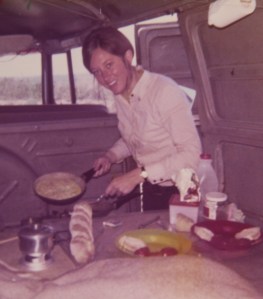
In the following summer-of-little-resources, we’d acquired a junked out, dented and twisted Volkswagen van that would crab along the highway at no more than fifty miles an hour. The passenger side door wouldn’t open and we had to push-start it for lack of a battery. But it was home for an unforgettable ten weeks that saw us through France, Spain and Portugal. We cooked on a tiny tin stove that burned small pellets just long enough to boil a cup of water or fry an egg. So we ate a lot of tomato and cheese omelets with bakery fresh bread and label-less wines from the small villages we lazily passed through. Just before we crossed the English Channel to London at the end of our journey, we picked up a Canadian couple who were hitchhiking and gave them the van for the same price we’d paid for it… nothing… which, of course, is what it was worth. We finished our journey hitchhiking. So after all this, I wasn’t the least bit worried about Felicity adapting to a strange new culture.

On our first assignment, Page sent us to a site they had so artlessly named 1102, a microwave repeater perched atop an isolated mountain about a five-hour drive out of Bandar Abbas. They had only defined the problem as “Something strange happened to one of the radios and we need someone to look at it.” Well, I was someone and I had eyes, so I guess that was a good call.

We flew to Bandar Abbas with a letter to the area construction manger telling him to give us whatever supplies we needed. I took a taxi from the airport to the field office, a small, rented house with a large yard, now filled with parked construction trucks and trailers. The area manager, a tall and skinny American with a balding head and black, horn-rimmed glasses, read the letter with his feet propped up on his desk. He nonchalantly tossed it in a pile of other papers and said, “So, what do you need?”

“Well, I need a four-wheel-drive vehicle, two cots, two sleeping bags, some water and some cash.”

“He screwed up his face and looked at me like I was a child. “So is this your first trip to this area? How long have you been in Iran?”

“I’ve been here about six months, I’ve been to Bandar Lingeh before and I’ve made a lot of field trips to other areas,” I explained.

“Then you should know you need a lot more than that.” He continued. “There’s nothing out there. No food, no water, no gas, no restaurants, no hotels and no stores. Nothing!”

“There’s people,” I suggested.

He screwed his face up in disgust. “They’re not people. They’re animals. They live like animals.” I guessed to qualify as “people,” they’d have to adopt the rigid rules of freedom.

“Well, I’ve got a map here and it shows some villages. I’m sure we can get by on what’s available.” The map was printed by the Iranian National Oil Company, the only oil company in the country. Although it looked like the Sunday comics, the map had a little red gas pump stamped by each village that had gasoline. Many of the villages in the area had stamps.

“That map’s a piece of shit. Listen, I’m telling you, there’s nothing out there. Our guys have been traveling those roads for months and they should know.” He switched from angry to confused. “And why do you need two cots and two sleeping bags?”

I called to Felicity and she stepped into the office. She was twenty-four, five foot three, a hundred and seven pounds with long, straight auburn hair and eyes that glittered like a Christmas tree. The manager bolted to his feet so abruptly that his chair skittered back and slammed against the wall. He gasped, “You… you can’t take a white woman out into that country!”

She'll be right, mate. I'm Aussie.

She’ll be right, mate. I’m Aussie.

“She’ll be right, mate! I’m Aussie,” she snapped with a smile. She wore an orange, long-sleeved shirt and fresh blue jeans with no holes. She’d been indoctrinated to the Iranian dress code for female travelers so she would fit in with the local women who wore chadors – black shawls that covered the entire body. Having learned to say, “Hello,” “Please,” “Thank you” and count to ten in Farsi, she could haggle in any market with the best of them. Those of us who took the few simple steps to show respect to the Iranians had no problems. Those who felt they had the right to act however they damn pleased because they were Americans had problems… sometimes grave problems.

As the manager settled back in his chair, I assumed he’d surrendered. “So can you get us the stuff we need?” I asked.

He picked up the letter again and noticed the signature was from pretty high up the ladder. “We’ll get a vehicle together for you, but it’ll take about an hour. Why don’t you go have an early lunch? We’ll have it ready by the time you get back.” He let out a sigh as he tossed the letter back into the pile.

When we got back they presented us with a short-wheel-based Land Rover loaded with enough camping supplies to get us to the moon. There were cots and sleeping bags, cans of food, bags of pasta and rice, a camp stove, pots and pans, lanterns, a tent, twenty liter plastic jars of drinking water, twenty liter tins of gasoline, a folding table and two chairs. There was even a little vase with a flower in it attached to the dashboard with masking tape and a note that said “Bon Voyage.” As we looked at each other, Felicity said, “Oh, how sweet,” as she elbowed me to keep me from rolling my eyes.

In parting, I asked the manager, “By the way, how do ask for gas in Farsi? I forgot.”

Bahnzeen haast injah,” he said, exaggerating each “h.”

Bahnzeen haast injah,” I repeated, and then muttered it several times to practice. “OK, thanks a lot. We’ll be on our way.” We left with several employees waving goodbye.

As soon as we got out of sight, Felicity and I made a pact. We wouldn’t use any of the stuff they had given us and would return the jeep exactly as it was to try to get our point across: that the country was indeed livable if Americans would only open up a bit. Sure, it wasn’t the Riviera, but it was quite pleasant and there was nothing to fear. Iranian people were indeed different, but they were still basically families who wanted to live in the peace that Allah would surely give them if they asked, as He had done for 2,500 years. Perhaps, I thought, we could learn something from them.

Because the road along the coast snaked around giant boulders at radically changing elevations, I rarely got the Rover past third gear, often shifting to first to get through deep ruts and giant potholes. The raging river from a previous adventure was reduced to a trickle in a wide, rocky valley with barely visible tire tracks. After about two hours, we had only gone about 70 kilometers, but the gas gauge was reading only about a quarter of a tank. As we approached a village that had a gas pump stamped on the map, I saw a boy of about 12 years old on a moped. He made a right turn onto a narrow road that apparently led to the village center. I said to Felicity, “There’s no way he rode that moped all the way from Bandar Abbas. There’s got to be gas here!” I decided to follow him.

Several yards later, the boy turned left onto a street parallel to the main road with several mud buildings hidden by the row of hills. As we passed through the streets, I didn’t see a single sign or any indication of a gas station. I started tapping the horn lightly and flashing the lights to get the boy’s attention. He looked around, stopped and got off his moped with a puzzled look on his face. I got out and asked him in a peppy bright voice, “Bahnzeen haast injah?” I’d forgotten the customary blessing from Allah before speaking. He looked at me like I was an idiot, shook his head, “no,” kick-started his bike and went on his way frowning. I said to Felicity, “That can’t possibly be the right way to ask for gasoline.”

I got back in the jeep and followed him a little further, tapping lightly on the horn and flashing the lights again. When he finally stopped again, he looked much more worried. I assumed he saw me as possibly insane. With a beaming smile, I motioned him to come to the cab of the truck and look inside. He hesitated, but then came slowly with widened eyes and cautious steps. I pointed to the gas gauge and said with descending intonation, “Boop, boop, boop, boop, boop,” while moving the index finger on my other hand down like the needle on the gauge. He just looked at me. I motioned him to the back of the jeep, removed the gas cap and extended my thumb and forefinger to look like a gas pump spigot. I put my finger into the tank and said with ascending intonation, “Guk, guk, guk, guk, guk!”

His face brightened up as he said, “Ah, bahnzeen!” He ran back to his moped and hopped on, kick-started it again and gave me the internationally recognizable curl of his arm that said, “Come on!” I followed him through the narrow, dusty streets to the end of town, then up a hill to a large yard with a freshly whitewashed house and, off to the right, a matching single-car garage with a closed aluminum door. Before we stopped, a man I guessed to be about seventy years old came running out of the house wearing a smile as large as his turban. His long sleeved, collarless white cotton shirt went to his knees, covering white baggy pants tightened in at the feet just above his colorful, pointed woven slippers. He seemed very proud of his hundred words of English and anxious to use them all.

“Praise Allah, my friend! How are you?” he asked through a set of sparsely spaced, gold-capped teeth.

“Hello, how are you?” I remembered the Iranian custom of never telling how you actually are because you might make the others feel bad if you tell them you’re not well. On the other hand, you might make them jealous if you’re feeling well and they’re not. So you never tell anyone how you actually are, but you do ask them how they are. It could get confusing, but unknowing foreigners usually earned laughs, not scowls.

“Welcome to our village.” He offered his hand as his smile widened across his weathered brown face with scruffy patches of black and grey beard. “And why has Allah sent you here?”

“I’m looking for the gas station. I need some gasoline.”

“Ah, that is why Allah has sent you to me!”

“Oh, so you know where the gas station is?” I was confused. There were no pumps, no signs, no smell of gasoline, no black oil marks on the ground; just the fresh, clean smell of the desert flowers surrounding his house and a magnificent view of the arid land below with the grey, hazy mountains in the distance. Surely he would send me somewhere else.

“No, no. I am the gas station,” he giggled. He trotted to the aluminum garage door and rolled it up to reveal twenty-liter tins of gasoline stacked to the ceiling. “How much you need?”

“Ah… well… I guess I just need enough to fill up.”

“Yes, yes, I fill you up. But first we must have tea.” He motioned us to follow as he hurried into the house.
We entered the large front room that had hardly any furniture other than a massive and thick multi-colored Persian carpet on the floor, curled at one end to fit inside the walls. Soon he appeared with a tray and the now-familiar metal teapot, shot glasses and lumps of crystallized sugar. We sat down on firm cushions with colorful, heavy wool coverings and began enjoying the break. Soon he asked, “Why so many of your countrymen pass our village but never stop? I see trucks like yours pass every day, same color, same sign on door, but no one stop.”

“Well, I guess they don’t know you’re here. They told me there was no gasoline in any of the villages outside of Bandar Abbas,” I explained.

“Why they never ask? It look like you ask boy. He bring you here.” He nodded his head to the boy, now standing in the doorway along with a crowd of other children studying the newly arrived extraterrestrials.

“Well, they say they’ve been asking for gas, but I think they’re asking the wrong question.”

“What they ask?”

Bahnzeen haast injah?”

The old man threw his head back and laughed out loud, almost tipping over backwards. When he recovered he said, “That mean ‘do you have gas?’ Everybody think you wanna know if they gonna fart.”

After a good laugh together, the old gentleman explained that the carpet on which we were sitting was five hundred years old… and he could tell us the names of all his ancestors who had sat on it. It was his treasured possession, and I felt a special honor being invited to join the spirit of his family. Felicity had a warm smile as she slowly moved her hands flat over the carpet, as if to feel its warmth. As we were talking, more small faces appeared beside the moped-boy in the doorway, and several others began appearing in the glass-less windows. The old man said, “I ask wife and daughters to come but they too shy. No speak English.” He chuckled again. “Maybe later.”

At the first lull in the conversation, I went out to my spaceship and got a magical device… a Polaroid Land camera! Most of the children had seen cameras before, but never one that would print instant pictures. All the children wanted some, so I used up all but the last pack of film that I would need when I got to the problem site. After an hour or so, we left for Bandar Lingeh with promises that we would soon return with more film… and more aliens who would start stopping for tea and bahnzeen.

In Bandar Lingeh, I went to the new telephone switching office that I’d visited on the previous trip. It was recently built and included bathrooms with showers and a small kitchen. A crew of about seven installers who camped there with cots and sleeping bags assured us there were no other accommodations in Bandar Lingeh and we would have to join them if we wanted to spend the night. All were from English-speaking countries. Taking what they said with a grain of sand, we walked into town and asked for a hotel by putting our hands together, placing them on our cheeks, tilting our heads to the side and snoring. We soon found a no-frills but charming little room on the second floor of a small hotel. Although the mattress was a bit lumpy, the sheets and pillow cases were clean and we saw no six-legged intruders. The small sink had hot water and the bath and toilet were down the hall. We went back to the telephone building to report our find and excuse ourselves from dinner, and also report to the amazed faces that we’d found a gas station in one of the villages along the coast highway. As we wished them goodnight, we promised that when we returned from 1102, we would spend a night with them to tell them more about our discoveries. None of them wanted to go into the village after dark.

We arose early the next morning with the sound of the mullahs peacefully singing prayers at daybreak from atop elaborately ornamented masonry towers. After a breakfast of pita bread, spiced yogurt and tea, we found a deli that made us submarine type sandwiches to take along for lunch, and headed out into the desert. In this area, the installers were right; there was absolutely nothing. We even found one tiny village that showed a gas station on the map but was completely abandoned. We weren’t completely right in our planning, but fortunately we had the extra gas. Praise Allah and the Americans.

Because 1102 was on top of a mountain and had two 10-foot microwave dishes, it was easy to spot from a distance, but not easy to reach because of the atrocious quality of the roads. We got to it at about one in the afternoon and found the electronic equipment only partially installed. The equipment racks were bolted to the floor and some of the wiring has been placed in the cable troughs, but none of the wires had been connected. The radio was a Lenkurt brand made in Canada with which I was familiar. It had an inspection door that was open, so I looked inside to find it stuffed with crepe paper packing material and mouse turds, instantly identifying “something strange” as something out of a Tom and Jerry cartoon. Mice were a very common problem with telecom equipment left idle for long periods of time. I looked for more rodent damage such as insulation nibbled off wires, but found no other problems. It looked to me like the installers simply bolted at the first excuse to get out of having to work. I took Polaroid photos to add to my mouse turd trip report.

When we got back to Bandar Lingeh that evening, we went to the telephone building and selected a yet-to-be-furnished office on the second floor to set up our cots. Then we went down to join the installers sitting around a large cable reel on its side that functioned as a table. Dinner was mostly canned goods: beans, sardines and spam. I suggested that they find a Filipino to join their crew because they were such good cooks. They said they didn’t like the “Flips” because they always stole their food. I didn’t bother to tell them about my experience with Uri and Kani during the 2,500 year celebration. But they wanted to know about the gas station, so I told them about the boy on the moped, the old man, the garage with the aluminum door, the house, the carpet, the tea and the Polaroid pictures. I even showed them the ones I’d kept. In the course of the conversation, they later asked me if I would show them where the gas station was the next morning. They all wanted to see it, so I agreed.

The next morning, we awoke again to the singing of prayers, but this time it was quickly followed by two of the installers screaming at the top of their lungs, “Shut the fuck up. We’re trying to sleep.” Felicity and I just looked at each other, and then went reluctantly down to join them for coffee. We had promised.

After a short session of inane small talk, the in-charge installer who I’ll call Dick said, “Well let’s get doing. We all want to see that gas station.” He seemed excessively anxious and I wondered why. It was only a gas station.

On the highway, Felicity and I were followed by seven installers in six vehicles: two short wheel-based Land Rovers, three long and a three-quarter ton Ford four by four pickup truck, all with the Page logo painted on the door. I assumed they wanted to fill each vehicle up, but when we arrived at the pleasant little hilltop station, they all raced out of their vehicles to be the first to confront the little old man who was walking briskly out of his house to greet us with his largest smile ever. But his elation was short-lived.

Dick was the first to reach him and shout, “Hi. How much you want for your rug?”

“Huh?” His eyes widened and he looked astonished.

Another installer tried to push in front. “I’ll give you five hundred dollars for it.”

Another shouted, “I’ll give you a thousand.”

Another shouted, “Can we see it? I might even give you more.”

“Fuck it! I’ll give you two thousand dollars without even seeing it. It’s 500 fucking years old, for Christ’s sake.” He had the cash in his hand and was shaking it in the man’s face. “Here! Two thousand fucking dollars for your rug.”

The old man silently looked from one face to another, to the cash and back to another face. His jaw slowly dropped as tears welled in the corners of his eyes.

One installer came as close to the old man’s face as he could. “Look,” he said a bit more quietly than the others. “We want to buy your 500-year-old carpet. Just tell us how much you want for it. We’ll work it out from there.”

As the old man looked at the ground, I came up beside him. His head reached just above my shoulder. I said to the installation team, “Look, his carpet has been in his family for 500 years. He doesn’t want to sell it. It means far more to him than any amount of money you could possibly have.”

“That’s bullshit,” yelled one of the installers. “We’re offering him more money than he’ll ever see in his stupid fucking life. Of course he wants to sell it.”

I put my hands on the man’s shoulders and looked into his eyes. I said calmly and quietly as if talking to a child. “Look, these men want to buy the carpet in your house. Do you want to sell it?”

He just shook his head slowly from side to side.

I continued, “But they have a lot of money and they’ll give you however much you want.”

“But what would I do with money?” he shrugged. “There’s nothing to buy here.”

“So you don’t want to sell it?” I asked.

“No…” He was speaking just above a whisper.

I turned to the group and announced, “He doesn’t want to sell his carpet. He has no use for the money, so he wants to keep it.”

“Well, fuck him then.”

“Yeah, fuck him.”

“Fuck the stupid son of a bitch.”

One of them spoke directly to me. “So why the fuck did you bring us all the way out here if he doesn’t want to sell his rug?”

“I thought you wanted to buy gas,” I shrugged. “If you’d have asked, I could have told you he probably wouldn’t sell it.”

“Well, fuck it then,” said Dick. “Let’s just fill up and get the fuck out of here.”

I turned back to the old man. “OK, they understand that you don’t want to sell it. But we do need to buy some gas. Can you fill us all up?”

He looked at the ground seeming even more distressed. Then he looked up and said, “I have no gas. I sell it all.” Then he pointed to another three-quarter ton Ford four by four pickup stopped at a small building about 50 yards down the road back to the main rutway. “They buy all my gas.” I could see the back of the truck was filled with the 20-liter tins. Two men came out of the building that I assumed to be a store and opened the doors to the truck. The old man continued, “They’re working on new road not far away. They have many trucks.” I started to chuckle. The old man looked at me and started chuckling too. Felicity joined in and soon the three of us were laughing pretty hard.

“What’s so fucking funny?” yelled Dick. “We don’t have enough gas to get back to Bandar Lingeh. We’re fucking stuck here!”

The old man stopped laughing and yelled, “Don’t worry, I fix.” He started running toward the other pickup truck flailing his arms and shouting in Farsi. It had just started to move, but stopped and the two men got out. After talking a while and looking back in our direction, the two men got in, started the truck and made a U-turn to come back to us as the old man hopped onto the back bumper. It stopped just a few yards in front of us and two six-foot-four burly Iranian men dressed in shabby work clothes got out and approached. The installers all took small steps backwards until the little old man came running around from the back of the truck shouting, “Everything OK. They give you gas… and I don’t mean fart.”

One of the Iranian men asked Dick, “Where tank?” Dick didn’t answer. Then he looked at the old man and said again, “Where tank?” Then he looked at the other man and asked again, “Where tank?”

The other man said, “Where tank?” then looked at the old man and repeated, “Where tank?”

The old man laughed, looked at one Iranian and then the other and said, “Yes, yes, where tank, where tank, very good, very good. I teach you English.” Then he scurried to the nearest vehicle, took off the gas cap then ran into the house. The two construction workers went to the back of their pickup and each took out a can of gas. The old man came running out of the house with a funnel, and the refueling process began. The installers looked on without speaking.

While holding the funnel for the first vehicle, the old man said, “They give you enough to get back to Bandar Lingeh.” His beaming smile had returned and the three of them continued until they’d put gas in each vehicle.

Dick pulled out his wallet, started fingering bills and muttered to me, “So how much do we have to give these assholes?”

The old man saw the wallet and said, “No, no, no. You no pay. Gas already paid for.”

“Yeah, but how much do we have to give these guys?”

“Nothing! These men paid.”

“But don’t we have to give them money to pay them back?”

“No, no, no,” explained the old man. “Gas has two places in Iran: belong to government or belong to people. This gas paid for, so now it belongs to the people. These men pay, so you don’t have to.” His smile widened. The two Iranians were leaning back on the front of their truck with folded arms and huge, toothy smiles.

Confused, Dick looked at me and asked, “So what the fuck do we do?”

I said, “Just… everybody shake hands, say ‘thank you,’ and we’ll go.”

The old man looked at the two Iranian construction workers, raised both his hands like a professor in a classroom and loudly instructed, “Now we say, ‘Goodbye.’” Then he repeated slowly, “Good… Bye.”

They each tried, “Good… Bye,” first to the old man and then to each other. They repeated it several times while chuckling.

The old man said, “Yes, yes, goodbye, goodbye.”

Everyone shuffled around for a while shaking hands and saying, “Thank you” and “Goodbye.” The two Iranian men still wore their toothy smiles as they got back in their truck and drove off, waving out the windows until out of sight.

The old man excitedly offered, “Now we have tea?”

Dick said, “We really don’t have time for tea.”

One of the installers yelled, “Ask him if he’s got any beer.” The rest chuckled.

Dick snapped over his shoulder, “It’s too early!”

As we all headed for our vehicles, Dick pulled me aside and said in a low voice, ‘These Iranians have got to be the stupidest fucking people on earth!” I didn’t answer because I was thinking how to politely turn down the tea. After the installers had left, I promised the old man we we’d return when I had more Polaroid film and we’d spend more time. He wished us Allah’s blessing as Felicity and I got into the Land Rover and drove off.

About five minutes down the road, Felicity finally broke the mesmerized silence with, “Do you think that carpet was really 500 years old?”

Click here for Chapter 9

2016 © Copyright The Other Third World

The Other War with Iran. Chapter 7, Yours and Mines

Having been introduced to the North and South of Iran, it was now time to visit the West. The satellite station outside the town of Kermanshah had a problem that an expert technician couldn’t resolve. The microwave radio system that relayed the satellite signals to Tehran couldn’t meet its noise specifications. Although I was a fairly good technician, the equipment was made in Italy by a subsidiary of General Telephone and I wasn’t sure I would be able to help. But Page Communications Engineers had a reputation as being a flesh merchant, meaning they mainly won contracts for the price they would charge for a certain number of warm bodies they would provide for a project, not for the quality of work they could produce. I was unaware that the technician who couldn’t solve the problem had not only failed to look at the site specifications, he wasn’t even aware that they existed. But I was looking forward to the trip because my Filipino friend, Uri from the mountaintop camping adventure would be at the wheel for the 300 km drive. He would also have any hand tools I might need to work on the equipment. It would be great to see him again.

The drive took just under five hours on a relatively straight two-lane highway with nomads walking along the shoulders with camels and donkeys. Uri warned me that the animals could be spooked by the passing cars if the driver honked the horn, as some of the lesser educated visitors to the country would do for entertainment. After passing through the quaint little town of Kermanshah, we drove along an arrow-straight section of highway where I could see every inch of the 11 miles ahead. Then, after negotiating the final curve in a small mountain range, we could see in the valley below the tremendous 120-foot satellite dish next to a shoe-box shaped building surrounded by a 10-foot high chain link fence with razor wire coiled at the top, at a distance of 100 yards from the site center. When we reached the guard gate, Uri, through his permanent and toothy smile, showed our badges and joked in Farsi with the four soldiers armed with machine guns. They waved us through with smiles and casual salutes. He’d been on the installation team that had installed the microwave radios and he took me directly to the equipment room that had the problem.

I found the expert technician asleep on a chair in front of four nine-foot high, 24-inch wide equipment racks that were humming away with no illuminated red lights to indicate any problems. After awakening him and introducing myself, he referred to the three-foot tall stack of test equipment on a wheeled cart in front of the equipment racks. He was a tall, lanky fellow with horn-rimmed glasses resting on his nose, wearing a plaid flannel shirt over a soiled white T-shirt and shabby jeans a size too large. Apparently, it’d been a while since he’d seen a shower or a toothbrush. After fiddling with a few knobs and switches on the cart, he clearly illustrated that the signal-to-noise ratio was outside of the specifications. That’s like saying that if you have five buckets of water, you can only have a half a bucket of slop to pollute it, leaving an acceptable 10 to one ratio of water to slop. But his meters showed that he had a ratio of eight to one. He explained to me in frustration that he had done all the adjustments he knew how to do and had repeated them several times. The equipment was junk, that’s all. I asked him, “What’s your receive signal level?” In the simile, it was like asking, “How much water is mixed with your half-bucket of slop?”

He said, “Huh?”

I said, “The strength of the signal coming in. To meet noise specifications, you need a strong enough radio signal coming in.”

He said, “Huh?”

I looked at one of the radios. It had a meter with a rotary switch on the right and one of the positions read, “Receive Level.” Even though it was made in Italy, the words were in English. I turned the knob and the meter snapped to “4.0” out of a possible 10. I asked, “What’s it supposed to be?”

He said, “Huh?”

I asked, “Do you have a copy of the engineering paper that tells us what it should be?”

He said, “Huh?”

“A stack of papers about an inch thick that should have come with the manuals for the radio,” I explained.

He shrugged. “There’s some stuff over there on that desk but I don’t know what it is. I haven’t looked at it.”

After about 15 minutes of sorting through, I discovered that the receive level should be “5.0,” so the signal coming in was too weak. As I tried to explain it in simple terms that he could understand, Uri reached up to the knob by the meter and turned it to the position labeled, “Distant Transmitter Power.” The meter showed “7.” Uri said, “Transmitter at other end, it look OK to me. We maybe need antenna guys.”

“Well, shit, then. I’m out of here,” said the expert. That’s not my job, it’s a different department.” As he headed for the door, he said, “Let me know when it’s fixed and I’ll come back to finish testing.” He left his stack of test equipment turned on. Uri and I looked at each other with a slight glance at the ceiling.

I called the engineering offices and explained the problem and told them they needed to send out an antenna adjustment crew. Then I said to Uri, “Well, since we’ve come so far, we might as well get as much information as we can. Let’s have a look at the tower and antenna and see if the problem is obvious. We’ll spend the night in Kermanshah and head back in the morning.” Driving in the Iranian desert was particularly dangerous at night. Drivers didn’t properly use dimmer switches and would turn their headlights completely off, then turn the high beams back on again, blinding oncoming drivers so they couldn’t see the people and animals along the sides of road. Several people had been killed.

We went outside to the tower that stood about 10 feet from the back of the building and looked up to see the 10-foot microwave dish mounted at the 180 foot level. I stood beneath with the military style compass Uri had provide me and saw that it was pointed at the mountain range about 10 miles on the other side of a flat, barren desert. The compass reading indicated it was basically in the right direction. But with a microwave dish, “basically” isn’t enough; it has to be exact. I wondered if we could get a more accurate reading by going out into the desert, away from the electronic noise and magnetism. So Uri and I jumped into the land rover and headed out the gate with another flourish of smiles and waves.

At the end of the driveway we made a right and went up the road about 100 yards past the chain link fence, then made another right and slowly drove out into the desert, avoiding rocks and things that looked like they might penetrate a tire. When we reached a point that we estimated to be exactly in the line between the dishes at each end, we stopped, got out, walked a suitable distance from the vehicle to avoid its magnetic effects and started taking compass readings. It was a pleasant sunny day with a slight breeze, not hot and quite refreshing to be in the peaceful tranquility of nature. But suddenly there was a storm in the lull.

One of the soldiers was at the chain link fence rattling it as hard as he could and screaming at the top of his lungs. I looked at Uri to ask him to translate, but he quickly said, “Shh, I listen to what he say.” He and remained perfectly still while listening intently for about half a minute. Then he said to me through his eternal smile, without adding the slightest trace of emotion, “He say we in mine field.”

“What!” I yelled.

“We in mine field. We step on mine… boom… we blow up. We die. We fuck up.” Then he giggled.

“What the fuck are we gonna do?” I was mortified. I had never anticipated what it would be like to be blown to smithereens. Now it was racing through my head, and wasn’t the least bit pleasant.

“Stay calm,” he said. “We not blow up yet.” He looked intently around the ground, still with his unbelievable smile. “Look! We see our footprints. Soldier say walk only where we walk before. We be OK.” He started taking careful steps to plant his feet exactly in the existing footprints. I hesitated, but with his assurance, started doing the same. Then he said, “They cross here. You get in; you drive. I walk in tracks and guide; we keep wheels in tracks.”

Uri held his eyes tightly shut as he took the few fresh steps necessary to get into the tracks. But his grin remained. I got in on the passenger side, taking the final step as a leap to avoid contact with the ground. Luckily I’d left the door open. After wiggling across to the driver’s side, I started the engine and saw Uri in the outside rear-view mirror. He was about 10 feet behind, walking slowly backwards like on a tight rope, looking down at his feet and balancing himself with his arms wide apart. Then he looked up, caught my eye in the mirror and started guiding me by wiggling his index fingers in the right directions to keep the back wheel directly in the tracks. Then he held his hands up to stop. He looked down and took two more paces back, then guided me again. We continued like this for about an hour.

When we finally reached the highway, I backed the Land Rover onto it, stopped and got out. Uri was standing in the middle of the road laughing. I grabbed him in a tight hug with his head into my shoulder and we both laughed raucously to tears. When I finally let him loose, he had the biggest smile ever. As we did a high-five, he said, “We OK man. It Miller time.”

We went back to the guard shack to thank the soldier who had warned us, then went to Kermanshah to find a hotel. We would be in Tehran about lunch time the next day and I would be sure to add the mines to my trip report, just in case the crew coming to align the antennas wanted to take come compass readings. But for me, the most exciting thing about going back to Tehran in one piece was that Felicity, my Australian fiancée, would at last be arriving from London. Hopefully, she would accompany me on any future trips to the outback of Iran.

Click here for Chapter 8

2016 © Copyright The Other Third World

The Other War with Iran. Chapter 6, The Flood and the Midnight Snack

A problem that would require engineering assistance had surfaced in a town called Bandar Lingeh on the Persian Gulf in the South of Iran. To assess it, I was scheduled to fly to Bandar Abbas, the largest city in the area, and go by road to the problem site. A driver would be waiting for me at the airport in a late-model Willis Overland, a quite comfortable vehicle for negotiating the pot-holes and ruts on the rocky road along the coast. But because it was almost always sunny in Tehran, no one had anticipated that the weather could be a deciding factor in the success of the trip. Although Iran is mostly desert, heavy rains in the mountain regions could cause flash floods in the rivers that flow into the Gulf, without any indication of a problem until actually arriving at the swollen banks. There were no bridges, so crossing the rivers required the water to be relatively low.

Finding the driver waiting outside the tiny airport presented no problem. We would leave immediately on the three-hour, 110 km trip to Bandar Lingeh. As we traveled through the barren desert, I watched the distant mountain ranges looming on my right with occasional glimpses of the Persian Gulf on the left. Soon we arrived at the first river crossing, but before we could even see the water, a 200 pound, soaking wet soldier of apparent authority stopped us, opened the driver side door and pulled out my docile chauffeur by his shirt front. After slapping him briskly across the face several times to get his undivided attention, he ordered him to go back to the Bandar Abbas army headquarters and have a helicopter sent immediately. As he ordered me out of the vehicle, he turned the driver’s head toward the river so he could see the stranded convoy with the soldiers standing on the roofs of the heavy-duty trucks that would soon be swept away in the rapidly rising current. The driver sped away without a single word in a cloud of dust caused by the spinning wheels. Before I could truly comprehend the situation, I was alone with the few soldiers who had swum to safety.

Because the Shah had ordered all military personnel to study English, I could communicate with them, even though the urgency of the situation combined with their lack of expertise made conversation a bit strained. They pointed out the shell of a bus that had tried to cross just a short distance away. It was crushed up against a huge rock with the windows broken out and water swirling through. The soldiers’ solemn and broken English succeeded in woefully reporting that they had found no survivors.

After an extremely tense wait of immeasurable time, a helicopter arrived and methodically lifted the soldiers off the roofs; and none too soon. We watched all but the last truck get slowly tumbled and turned by the relentless river, then disappear into the rolling brown rapids as they washed downstream. Soon the remains of the bus joined them. Not much more was said as a transport truck came to take most of the soldiers back to Bandar Abbas. Four remained to make sure no one attempted to cross. My driver at last returned and the soldiers advised us that the waters could perhaps subside within a few hours… or it could take days. There was no way to know. All the other cars that came to cross turned back, but the ones we could see on the other side of the river waited. The desert landscape suggested that there was nothing for them to return to. Although Bandar Abbas was the largest city in the area, its hotels weren’t much better than camping out. And the driver had assured me that the Willis was loaded with all the necessary provisions. So after considering all the issues, I decided to wait it out with the soldiers. It was an hour or so before sunset.

Shortly, a person walking up the river bank surprised me by shouting out my name in perfect English. He was a short, lumpy Irishman with blond curly hair and blue eyes, about forty-five years old whom I had met in our office building in Tehran. He worked in the test engineering department across the hall and we’d met informally and had chatted a few times before. He had an empty twenty-liter heavy plastic jar tucked under his arm and his hair was wet. He wanted to know if there was any way he could get a ride into Bandar Abbas. I asked him what the Hell had happened.

With an admirable and ornery grin on his face, he explained that his jeep was on the other side along with his driver. But his wife was flying into Tehran at midnight, and no power on this earth was going to stop him from meeting her. He had emptied and dried the inside of the water jar, stripped off all his clothes, put them inside, screwed on the cap and jumped into the river hugging it like bear clinging to its baby. By kicking his feet furiously, he had managed to reach the shore about a mile downstream. Would I be able to take him to the airport in Bandar Abbas to see if he could catch the next one-hour flight to Tehran? There was no way I could refuse.

When my driver and I returned just after sunset, the river had shown no signs of subsiding. We all began chatting to pass away the time. The driver spoke very good English and we all got to know each other while learning a few extra words in each others languages. After a while we were all getting hungry, but the soldiers admitted that all their provisions were on the trucks. I assured them that I had enough food for everyone, but when they saw the cans with the foreign labels, they politely refused. They were Muslims and were afraid that there would be pork products inside. They turned down even the tuna fish and the sardines because they could never be sure. My driver said he would fix something for me, but the synergy that I had learned earlier from Mr. Chief Engineer Agha Mohandess Shababian started to kick in. I thought it would be quite rude to eat in front of them when they had nothing, so we would share the discomfort together. But by two a.m., the persistent river had not dropped an inch and we were all as hungry as teenage wolves.

When I offered to drive back into Bandar Abbas to look for something they could eat, the youngest of the soldiers had a better idea. He said that he had grown up in this area and there was a restaurant just a short way down the road. He even knew the owner. The other soldiers just laughed at him telling him he hadn’t grown up enough to know where he was, and that there were no restaurants for miles. They were well-trained in that area and knew everything about it. But the young fellow continued to insist and, after a short and jovial argument, the chorus of grumbling stomachs took charge and we decided to give it a try. Although not a single vehicle had approached since sunset, the soldiers drew straws to see which one would stay on guard to stop any unwary traveler that might try to cross. The rest of us piled into the Willis.

Only a few hundred yards on the road back to Bandar Abbas, we made a left onto a narrow and trampled pathway that I would not consider to qualify as a road. The Willis slowly groaned and grumbled over waves of irregular terrain until we soon arrived in a small village with about seven unmarked and long-before whitewashed mud buildings on each side of the now wider trail. After the young soldier told us which one was the restaurant, we got out and went up the stone steps of a porch-like structure with a corrugated galvanized steel roof supported by flimsy sapling trunks. We found the owner asleep in a cot set up to block the entry like a human burglar alarm.

The young soldier woke him up and told him the problem. After offering mutual blessings from Allah, he apologized that he was too sleepy to get out of his cot. But if we wanted a meal, we were welcome to cook it ourselves. There was dough already prepared, hot coals in the dome-shaped oven and plenty of wood to get the fire hot enough to bake some bread. Allah had also provided fresh eggs and clarified butter. And of course, he trusted the young soldier to do the cooking because he had known him since he was born. But he was simply not going to get out of the cot. We would have to carry it away from the doorway with him in it, and then return it when we had finished washing the dishes. Would Allah please help us not to jostle him too much? We could leave some money under his pillow as we left.

After moving the assembly of man and cot, we fumbled our way into the dark room. The young soldier found a kerosene lamp and lit it, illuminating a humble country dwelling with shades of the past centuries showing in every nook and cranny. A low wooden table seemed to be hand-made of thick branches for legs and irregularly hewn boards for a top, worn to a shine by ages of use. It was surrounded with ample cushions covered with a thick woolen fabric that I’m sure was once brightly colored. The walls had brownish photos inside rustic wooden frames. Some of the adornments on the wall seemed to have a second purpose, like the three-foot steel rod that I didn’t yet recognize as the bread hook.

Luckily the young soldier knew exactly what to do. First he tossed some wood onto the coals and fanned them to get the oven hot. Then he flattened bread dough on the table, formed it into two-foot, half-inch thick ovals and firmly pressed in handfuls of the coarse gravel that was in a pile near the oven. Then he slapped the loaves into the clay dome oven so that they would stick to the inside walls. He then readied a smaller fire on the side to heat up an ancient cast iron frying pan for the eggs.

When the bread was golden brown, he pulled the loaves off the oven wall with the hook he had removed from its nearby storage place. As he slammed each flat loaf on the table, the gravel popped out and skittered in various directions, leaving lacy bread that could be broken apart into crusty little fingers. He served us each three eggs sunny-side-up, sprinkled with black pepper and swimming in clarified butter. We could spoon on the chunky, spicy red sauce to taste, then swirl bits of the warm bread into a mixture made by mashing the eggs with a fork. We drank strong, black tea served in little shot glasses with small chunks of crystallized sugar to suck on to sweeten it in out mouths. It was one of the most delicious meals I’d ever eaten.

As the young soldier had now earned the respect of his peers, he was placed in charge without word or fanfare. As he prepared a make-shift take-out meal for the soldier left at the river, he told the others how much money they would have to pay. I could not contribute because I was the visitor. And they, of course, were the soldiers tasked with serving whoever may happen to be in their country. As we left, he gently placed a small handful of coins under the owner’s pillow without waking him, then directed the other soldiers to help move the cot back to its original position. Then he nodded approval to return to the river.

I took a nap in the passenger side of the Willis and, well after the sun had risen, saw that the river had subsided enough for us to say goodbye to the soldiers and be safely on our way to more of the Persian Gulf. As the tension of the adventure had passed, I began wondering what the problem requiring engineering assistance in Bandar Lingeh might actually be. As we lurched along the rustic dirt road for a little over two hours, we saw very few vehicles other than an occasional antique bus or an overloaded, ten-wheel Mercedes truck lumbering by. Near the small groups of mud structures I assumed to be towns, we saw mostly mopeds and animals and only a few cars or pickup trucks.

We finally arrived at the target site, a two-story, freshly constructed telephone equipment building on the edge of town with a microwave tower and a chain link fence partially constructed. The parking area was freshly paved and was littered with Page vehicles, cable reels, trailers and various crates of electronic equipment, some empty and some yet to be opened. Inside, a gentleman of about 30 broke away from his installation task to introduce himself as the technical installation supervisor, speaking with a British accent. I’ll call him “John.” He was unaware of any engineering problem in his department, but there was another fellow working in the standby generator room. But that was a different department.

I went out of the building and found the entrance to the equipment that would automatically provide electrical power in case of an outage. Inside, a gentleman who was puttering with some equipment identified himself as the clean-up man sent to polish off the minor issues found on the final inspection of the installation. He claimed to be from Ireland, but I assessed that the nation would be reluctant to claim him. He was short and thick, dressed in filthy, almost worn out clothes, had an unkempt, short beard and reeked of sweat and un-brushed teeth. I assumed he had been hired from the floor of a pub.

“Are you the one who called for engineering assistance?” I asked.

“Indeed, I be,” he replied and then chuckled. “I have a question about the conduit clamps.”

“The conduit clamps?”

“Yes, there’s a few missing on the run up the wall inside the closet there. I’ve got some clamps and tools to install them, but I don’t know whether to use straight-slot or Phillips screws.”

“That’s your question?”

“Indeed it be. The drawings have been taken away and there’s no information here.”

“So how much time do you have until your year is up,” I asked. All employees would get a 15% bonus after staying a year in the country. But they must stay the full 365 days to earn it. Then they could go home.

He pulled out a pocket watch, opened the cover and scrutinized the time. “Six days, three hours and twenty seven-minutes.”

Problem solved. He was a short-timer. I realized that he would be gone before anyone in his department even read my trip report. So for the sake of courtesy and pity, I posed as a person thinking for a few seconds and said, “Use straight-slot screws.”

He looked at me sorrowfully and said, “Well, I don’t have any straight-slot screws.”

After returning to my think pose for two seconds, I said, “Well, then, go ahead and use Phillips.”

“Well, I’ve got some Phillips screws, but I don’t have a Phillips screwdriver.”

“Well, why don’t you just zip into town and buy either some straight slot screws or a Phillips screwdriver? Either one will do.”

“I don’t have any money.”

I gave him the equivalent of ten dollars in Rials, the Iranian currency. He snatched it out of my hand, but then said, “But I don’t have transportation.”

I called to my driver who was taking a nap on the front seat of the Willis. “Do you think you can find a hardware store so this gentleman can get a screwdriver?” Huge mistake! I should have given the driver the money and told him what to buy. They came back two hours later with the driver rolling his eyes and the short-timer drunk. He had no screwdriver, screws, money or a receipt.

I said to him, “You know, if you worked for me, I’d fire you on the spot.”

He laughed and said, “Yeah, but I don’t work for you. And I’ll be long the fuck gone before anyone knows.”

I didn’t bother to ask his name.

Click here for Chapter 7

2016 © Copyright The Other Third World

The Other War with Iran. Chapter 5, Karl and the Kops

Page Communications Engineers had more than 2,000 employees in Iran, all from various countries around the world. Each was paid their normal wages for the positions they held in their home countries, but with a per diem allowance that would cover their living expenses. To attract even more of the best workers, the pay package added a 15% bonus for completion of a one-year contract to give each worker the equivalent of a year’s pay saved in the bank at the end of their stint. But only if they lived within their standard economical means while in Iran. But a German engineer I had met in the hiring process in Munich, whom I’ll call Karl for the sake of his privacy, had chosen to live well above his standard economical means, a temptation to all of us but only practiced by a few.

While waiting for his newly wed wife to join him, Karl had chosen an expensive, two bedroom luxury apartment in a neighborhood filled with doctors, lawyers, statesmen and others who had garage-door openers and luxury automobiles. But because Karl’s wife would not arrive for a few more months, he was quite lonely in the apartment and was looking for a temporary roommate. Everyone he had asked had turned him down because of the price he was asking.

But I liked Karl. He was quite a genial fellow, tall and lanky, with dorkishly thick glasses and a fountain of straw-colored hair that stood up in the front, making him look a bit like a scarecrow on its way to Oz. He always had a wry smile and an instant, comical comment for what we both knew to be inept management that had no concern whatsoever for anything or anybody who stood in the way of profit-maximization. But as a brilliant engineer with a strong sense of fair play, he managed not only to make excellent contributions to the project, but to steer the management morons in better directions, in spite of their lame assessments of themselves and their present surroundings. Karl also saw the Iranian people as equal human beings with different forces forming their behavior patterns, not as people to ridicule, fear or despise. So when he made me an offer to live with him at a price slightly less than my one-and-a-half-star hotel, I quickly accepted and moved in, along with my only prized possessions, my portable stereo and black market cassette tapes of Woodstock musicians that I had acquired in Singapore on a previous adventure. But Karl’s naivety and lack of street smarts, mixed with his tendency to get his nose too deep into the bier mit schnapps every night, got him into a precarious situation one night with the local beat cops.

I had just returned from a field trip and found him sitting on the couch with two uniformed patrolmen who normally spent their evenings casually strolling the streets of the park-like neighborhood. In his thirst and loneliness, he had invited them in for a cold drink to while away their mutually boring hours. However, as I quickly realized, the two cops didn’t see him as a kind and hospitable neighbor. They saw him as a fool. Street cops in Iran were not normally considered potential friends by the upper class.

Their Bohemian greeting instantly gave them away. With their alcohol-laced breath preceding them, they lavished me with exaggerated bows and praises in bits of English and Farsi like I was their long-lost uncle returning from the war. As I politely turned down the offers to join them, I noticed their wrinkled, soiled and slightly frayed uniforms as they returned to the couch, insisting that Karl sit in the middle. As they put their arms around him, instantly offering to refill his glass after every sip, I assumed they would search for the presence of a feminine side to further enhance their evening. Assuming that Karl was a big boy and could handle himself, I excused myself to retire for the evening. On my way to my bedroom, I stopped in the half-bath connected to the dining room and noticed the cops’ garrison caps resting on the back of the toilet. I saw it as Fate giving me the opportunity for a bit of revenge.

While relieving myself, I released a slight drizzle into the satin upper lining of each cap. If not on them directly, I thought, then on them figuratively. I went to bed snickering under my breath.

When I awoke, I found Karl sprawled out on the couch and the door wide open with no sign of the two cops. I woke him up and went to make some coffee. When I returned, he was on the phone, apparently talking to the boss in his learning-stage English. One of his reasons for my reduced rate as a roommate was that I could help him improve his skill in the language of business, power, war and self. I got a good laugh hearing him tell his excuse for being late, “Ze alarm watch went off, but not me!” As I left for work, Karl said he would get cleaned up and be there in about an hour.

Karl arrived at the office with a very worried expression. He confided that his memory was a little fuzzy from the night before, and he couldn’t remember if he had given me any of the money he had owed me for a previous transaction. He had been paid the day before and had a month’s pay in his wallet. But when he checked it after I left that morning, the money was gone. I told him that he had indeed paid me what he owed me, and he was a bit relieved. But he was still missing the rest of the money. We immediately suspected the two cops. Karl was a bit reluctant to make a report, but I adamantly wanted to. He used the excuse of being too busy to avoid having to go to the cop shop, but I used the excuse of not yet having been assigned to a new problem to go immediately and make whatever kind of report I could.

The commissary was easy to find and the desk sergeant translated my attitude enough to send me to the captain who understood enough English for me to tell him what we thought had happened. Both he and the sergeant were well-groomed, wearing a clean and fresh uniforms and seemed greatly concerned that two of their officers would be drinking on duty, especially in that neighborhood. So the captain asked me if I could identify them. I thought that maybe I could, so I agreed to come back at seven o’clock that evening when the night shift came in for briefing before going out on the streets. Karl rejected the invitation with what I assumed to be fear of the unknown. This was not uncommon with engineers familiar only their home country and who’d been indoctrinated to their new one with only insipid propaganda. So I had to go alone.

When I arrived, the captain assembled about thirty officers in three ranks and asked me to inspect them to find the two who were in the apartment. As he ordered them to attention, my first thought was that I would not remember exactly what they looked like and wouldn’t be able to identify them positively. But a flash of memory shot into my head. I asked the captain if he could have them remove their hats and hold them in front of them with the insides showing forward. If I were unable to distinguish the features of the faces, perhaps I could distinguish the drizzles of piss from the sweat stains. At least it was worth a try.

I began pacing slowly along the first rank, looking into the eyes of the officers and then into their hats. All remained rigidly at attention. After passing the first few and seeing no stains at all, I could clearly see that perspiration would stay in the sweat bands and couldn’t reach the satin lining on the inside of the top. I became more confident and actually began enjoying it. For the first time in my life, the pigs were at my mercy. I remembered the harassment at the Vietnam demonstrations and the abuse of the war protesters in the United States by the police. I also knew that all cops weren’t alike; it was the inept few who made the whole force look bad. And now it was my turn to help root out a few of the rotten apples. I was elated. I began to think that the culprits’ guilt would also be a giveaway. So I concentrated more on their eyes, paying only casual attention to the condition of the cap linings.

Most of the faces remained calm and confident as I approached, and most of the hats were relatively clean. But about a third of the way through the second rank, I noticed one cop with wide eyes and his head slightly trembling from the neck. His uniform was also unkempt, unlike most of the others. I focused more directly on his eyes, which became wider as the trembling increased. I stopped and glanced into the hat. Sure enough, there were a few stains with a brownish border, possible only from drops of a foreign liquid. Looking directly into his eyes I said, “You! You were in my house last night.” He gasped as I told the captain he was definitely one of them. I decided I would have even more fun finding the second.

I began glancing into the hats three places ahead so that I could identify the second guilty officer before getting close enough to look into his eyes. And sure enough, I saw the condemning stains well in advance. But I nonchalantly passed by him to torture him with a slight sense of relief. I noticed the wide eyes and trembling neck slightly relax. But three clean hats later, I spun abruptly around and pointed back into his face. “You,” is all I said. Then I put my nose six inches from his. Tears welled in the corners of his eyes and I gave the captain the second positive identification. He released the rest of the officers to their duties, and as he walked me to the door, he told me they were indeed the two officers assigned to our neighborhood. An investigation would begin immediately. If the money was found in their possession and Karl could identify it by serial numbers or markings, it would be returned to him. But the thieves were probably smart enough to have it well hidden. Karl would also have to identify them from a standard police lineup, as in any normal criminal investigation. So there would be no chance of him seeing the stains. If he couldn’t identify them, but would testify that two officers were indeed in his house drinking alcohol, they would probably be dismissed on the weight of my positive identification.

Up until that time, most of the Page employees only thought of cops as the SAVAK agents, the secret police used to root out dissenters of the Shah. One of them was a driver for our department who, on the few instances we used him to ferry us to various events related to the project, would respect no traffic laws, drive on the sidewalk and even try to run over the toes of other cops trying to direct traffic. He was immune to any criminal prosecution. His example gave us all a bad taste for Iranian police in general. But like most people going about their business in most nations, we rarely had any other encounters with the police. I had hoped that my story about the reasonable and professional captain and sergeant would help my fellows realize that the Iranian people in general were well worth knowing as friends, and that we should not let the few that made a bad name for everyone spoil our opportunities to enjoy our stay.

I continued living with Karl until his wife arrived at about the same time my Australian girlfriend, Felicity, arrived from London where she had been studying midwifery. We rented a lovely little upstairs apartment in a home in a middle class neighborhood of Tehran. The elderly couple who owned the house became friends and, because we made so many field trips to the remote parts of Iran, we rarely spent any personal time with the engineers I served. I only saw Karl a few times again in the office while trying to sort out other problems on the project. We never spoke of the incident.

Click here for Chapter 6

2016 © Copyright The Other Third World

Another Non-Judicial Execution

Non-judicial executions in the United States date back to Columbus. His logbook reports finding friendly and generous people, but “With fifty armed men we could subjugate them all and make them do whatever we want.” The Indians’ subsequent revolt earned them the label “bloodthirsty savages” to rationalize, “the only good Indian is a dead Indian.” After WWII, globalization slaughtered three million Vietnamese to execute any dissidents labeled “Charlie.” Today, drones execute goat-herders with towels on their heads who hold sovereignty more important than the dollar, dubbing them “terrorists.” Many Americans want to convert the entire Middle East to “a parking lot.” Some want to execute all blacks, all Jews or all whites.

Non-judicial executions form an integral part of our entertainment culture. Liam Neeson recently played a hit-man whose son was in danger of being hit, so he began executing dozens of other hit-men. We rationalize by ignoring that the executed were also somebody’s sons. To boot, children see 16,000 murders by age 18 and we revel in the mass executions of the “Walking Dead.”

So why are Americans so surprised when one of us twists logic to justify his own personal non-judicial execution, such as Columbine, Charleston and now Umpqua?

The president suggests banning hand guns to stop personal non-judicial executions. How about banning all weapons of execution, including drones and nuclear bombs? Perhaps if the leadership ethic would cease non-judicial executions, the rest of our mentally unstable cowards would follow suit.

I’ll continue to move this article up to the top of the list each time there’s a mass killing in the United States, regardless of the political blather or new unenforceable laws that would create yet another illegal cash cow. The root lies in, “Life, liberty and the pursuit of happiness. Um… MY happiness. I’m not particularly concerned about yours.”

Peru’s motto dates back to the ancient Incas: Ama sua, ama quella, ama llulla. “Don’t lie, don’t steal, don’t seek vainglory.” Image that being the mantra in the Boardrooms and the Beltway! Perhaps then we could have the America we say we have.


2015 © copyright The Other Third World

Money, Community, a Dog and a Goat

Let’s just say all you want is money. You don’t give a rat’s patootie if new-born infants die in the streets with pus coming out of their eyes. As long as you have a big enough pile, you can do whatever you want. And you wanna be a leader so you can tell everyone else what to do. So how do you do it? You can’t just go up to people and say, “Vote for me, I don’t care about you.” So clearly, you must avoid Truth at all costs. You have absolutely no option but to lie. And, of course, your very first lie has to be, “Money isn’t important to me; I only care about you.”

Now let’s just say you really want a better community. You want everyone to thrive with no crime or pollution. And you want it to last. So you have to stand firmly in the face of Truth. But… you’re clearly blocking the path of the glutton who must now create his second lie, “He doesn’t care a about you. All he wants is money.”

In a small community, five candidates on each side struggle for leadership. How do they build their parties? Surely, the true community leaders are going to have a tougher time. One wants better healthcare, one wants better education, one wants jobs, one wants housing for all, one wants to improve transportation, one wants a cleaner environment, one wants equality… Wait! That’s too many. Which is the most important? They argue bitterly, struggling to better their community but making tremendously slow progress.

So what do the money lovers do? One says, “We need to cut costs!”
The others snap to attention. “Yeah, we need to cut costs!”
Another says, “People should get their own healthcare.”
The others snap to attention. “Yeah, people should get their own healthcare.”
Another says, “People should get their own jobs and housing, and should all buy cars.”
The others snap to attention. “Yeah, people should get their own jobs and housing, and should all buy cars.”
Another says, “The environment’s plenty clean enough. In fact, we can pump even more crap into it and make more money… I mean, still get by.”
The others snap to attention. “Yeah, the environment’s plenty clean enough. In fact, we can pump even more crap into it and make more money… I mean, still get by.”

Total unity on all issues.

When leaders can’t lead, the followers must. Politics 101.

Now let’s think up names for these groups. The first group loves money, so how about “Money-ists.” Well, that sounds a bit awkward, so let’s think up a cuter word for “money.” How about “capital?’ Yeah, that brings up spine-tingling visions of patriotism, like the capitol building in Washington, DC. “Capitalists.” Great name.

Now how about the other group? They love their community, so how about “Community-ists.” Well, that sounds a bit awkward, so let’s shorten it to “Communists.” …Oh, poo! That’s a bad word. A really bad word.

The first time I heard it, I was in the fifth grade. The teacher told us Communists were evil people who hated their neighbors and would call the police if they did anything wrong. The police would come and torture them. No one had any rights and they were never allowed to leave their country. But worst of all, they didn’t believe in God. Instead, they worshiped an evil man named Stalin.

One morning she read from the Bible, “And Jesus said, ‘Cast aside thine earthly goods and follow me.’” Then she slowly and solemnly closed the Book, sat demurely on her stool and said, “Well, that was then and this is now. In America, we don’t have to give up all our nice things to be Christians.” With enough money, you can even change the Bible.

So which am I, a Communist or a Capitalist?

While in the fifth grade, I lived on an 11 acre farm in West Virginia. We had a faithful Airedale who truly wanted to protect us, and a goat who wanted to eat everything in sight. The dog was fed twice a day, but would beg for scraps and be rewarded with hugs and affection. The goat watched. The dog would poop after circling a grassy spot and hunker down to let go wearing a noncommittal expression, drawing no attention. The goat could outdo that. He’d crap while doing pirouettes in the air, scattering his shot in all directions with arcs of squirting pee, providing belly laughs for the three school kids. The dog would go to the porch swing, hop on and take a nap on the calico cushion. When he left, the goat would try. He’d put his front hoofs on the swing, but that would push it away. So he would baby-step his hind legs closer, pushing it even farther, then he’d lift on a wobbly back leg. But once the other leg left the ground, the swing would swoosh forward again, rolling him back on his bleating butt. More giggles.

So which am I, a dog or a goat?


2015 © copyright
The Other Third World