Alo’ha, Ha’ole

The Hawaiian greeting Alo’ha comes from two words in their ancient language: alo, “to share or give,” and ha, “breath” or “the breath of life.” Early Hawaiians would greet each other by touching noses and foreheads simultaneously while inhaling and exhaling, thus sharing a breath or two. This assured their mutual respect for each other, the land, the ocean and the sky.

The modern word for foreigner, Ha’ole, also comes from two words: ha, as already defined and ole, “no,” or “without,” forming the idea “one who has no breath to offer.” But the term was used long before the arrival of the white man to identify uncaring people who sought only pleasures for themselves at the expense of everyone else, with little regard for their environment. As the centuries passed, the white man proved himself quite worthy of such a title.

Today, Hawaiians use the term mostly in a friendly way, but can make it derogatory by preceding with an expletive. The “F” word works fine. Latinos use the word “Gringo” in a similar manner, and those of African descent can do the same with the “N” word.

– Ha’ole research, thanks to Kalani Dapitan

Watch for my story “In the Trenches of Paradise” documenting nine months on Oahu, not as a tourist but with the economically enslaved Hawaiians needed to support those who must ask, “Are we having fun yet?”


2015 © copyright The Other Third World

The Other War with Iran. Chapter 4, The 2,500 Year Celebration

Most historians consider Persia – the original name for Iran – to be one of the oldest civilizations on earth, founded in 550 BC by Cyrus the Great and maintaining its sovereignty over several centuries, despite radical regime and boundary changes. Consequently, it had a 2,500 year birthday in 1950. But the enormously popular leader at the time, Mohammad Mosaddegh who had nationalized the nation’s petroleum industry and oil reserves, saw no need for an international celebration. However, in 1953 he committed the unforgivable sin of attempting to audit the American and British oil companies that were beginning to rob his country blind. So the CIA orchestrated its very first covert operation to depose a legally elected official, and then installed a puppet dictator named Mohammad Reza Pahlavi, more commonly known as the Shah of Iran.

Because of his attempts to westernize Iran, the Shah gained a popularity of about 30%. To win the hearts and minds of the 70% who preferred to trust in God rather than the dollar, he devised several cheap tricks – the most heinous being the secret police, SAVAK who would slaughter any man, woman or child who spoke ill of him. He also passed a law requiring all businesses to display a picture of him or his royal family on a prominent wall, or risk the business shut down and the owners executed. Lesser carnival acts included calling himself, “Shah Hahn Shah (King of Kings),” wearing a snappy uniform and flying his own jetliner. But in spite of all this, he maintained warm and cozy ties with Washington and London by promising not to audit the oil companies that were robbing his country blind, as had done his predecessor.

Perhaps his most elaborate publicity stunt – and perhaps the most elaborate of all time – was the 21-year-late, 2,500 year multi-million dollar birthday party for his nation in its ancient city of Persepolis, built by Darius the Great in 513 BC and one of the most prominent ancient ruins in the Middle East. The 500 lavish guests included another ruler of an extant ancient monarchy, Emperor Haile Selassie of Ethiopia, along with Vice-President Spiro Agnew, Princess Grace and another sixteen presidents, nine kings, five queens and two sultans. Clearly, the King of Kings could rub elbows with the Cream of the Cream.

And to assure his gala event reached the entire planet, he’d waited until his brand new telecommunication system was tested and ready to reach the satellite up-link station at Kermanshah for worldwide distribution. To get there, the signal had to pass through several microwave relay stations equipped with two sets of everything needed for transmission, along with an automatic transfer system to keep the predicted outage time down to a few seconds a year, making it one of the most reliable systems on earth. All sites ran on commercial AC power but had a battery backup system and a standby diesel generator to keep the batteries charged during a power outage. Still, the King of Kings insisted that for the 30 days previous to the five-day event, each site be manned by an engineer, a technician and an installer to ensure that no force whatsoever could disrupt his show. I was assigned the engineer position at a site called Dukuhak, two hours out of Shiraz.

My team included a Hawaiian technician I’ll call Kani and a Filipino installer I’ll call Uri. We met for the first time on a Monday morning in our field office in Shiraz, and after strangely non-committal handshakes, set out in a long-wheel-base Land Rover with the company colors to get supplies for a four-week camp-out on a mountain top in the middle of a bleak and unforgiving desert. The relay station itself would only have room for cots between the aisles of equipment, and there was no bathroom or water. While we were scrunched into the narrow front seat of the Rover, the distance between us remained vast. Kani and Uri obviously knew each other, but didn’t care much about the newcomer. From their muttered conversation I picked out the gist of it, “We’ll share our food but the fucking Yank can cover his own ass.”

I tried joining in, “Hey, why can’t we all share? I’ve had roommates before.”

Uri looked at me through his permanent grin, but his tone of voice couldn’t hide his disapproval, “Naw, man, you Yanks don’t like to share food. It’s always, ‘no that’s my cheese, don’t eat it’ or ‘get your own bread.’ We don’t want to have to bitch over every bite.”

“Well I’m not like that. I can share food. I’ll eat whatever you guys like.”

Kani leaned over from the wheel to look directly at me. “Hey, man, we’re Asians. We eat a lot of rice,” obviously trying to put me off. But he didn’t succeed.

“Well, I can eat rice.” I’d spent a lot of time in the South and thought of New Orleans red beans and Mississippi rice and gravy, along with visions of flied lice in Japanese and Chinese restaurants. Mmm… But as my appetite took control of my voice I pleaded, “But can we have potatoes once in a while, just for a change? You guys could eat a potato now and then, couldn’t you?”

Uri looked at me suspiciously then turned to Kani. “You can eat potato now and then if it please the Yank?” His disapproval was waning.

I was leaning forward in the seat so I could see Kani. After a quick glance into my eyes he answered, “I guess maybe so. He don’t look like no normal Ha’ole to me.” I felt complemented, but I was unaware that the endearment came from the old Hawaiian language meaning “one who lacks breath,” or “one who cannot share his planet as it was created.” Click to read “Alo’ha, Ha’ole”

As we traipsed through various bazaars to get cots, water and food, I realized this wasn’t a new experience for them. The company had told me at the indoctrination lecture to be aware of open markets, but these two seemed quite at ease. They knew enough Farsi to haggle prices for a camp stove, charcoal, a cooler and dry ice. Conversation revealed that they’d both spent several days on similar undertakings during the installation and testing processes. Uri had even camped out at Dukuhak before. Because I’d submitted the lead to the more capable, the tension softened even more and rewarded us with a deck of cards to accompany the folding table and chairs. We all played hearts, a game similar to bridge or pinochle but a bit easier. Neither of them drank, so I decided to forgo beer to avoid additional alienation.

After an hour of smooth travel on the highway, we turned onto a one-lane dirt road as we saw the site on top of a nearby mountain. When it started getting steep, Kani stopped and kicked in the four-wheel drive. For the next 45 minutes, he expertly maneuvered through ruts, rocks and loose gravel, shifting gears as necessary to maintain the safest speed while avoiding plummeting into the surely fatal chasms that moved from one side of the road to the other as we twisted around the switchbacks, a few of which required stopping and backing up. The whole time, the engine purred smoothly as if driver and mechanical beast were one.

We finally arrived at the concrete block, 10 by 16-foot repeater site in mid-afternoon with three stomachs audibly growling at the delay. Uri immediately volunteered to cook, and started picking out what he needed while unloading supplies. He was about five feet tall and sturdy as a Shetland pony. Kani came in at about six feet but with a bit of a sagging belly. He did the bulk of the unloading work, seeming to know exactly where to put everything. I stayed out of the way.

Soon the site was alive with the savory aroma of Filipino-style chicken adobo cooked in soy sauce, ginger, garlic and hot chili peppers. Uri served it with two scoops of rice in traditional Hawaiian fashion. It was good that both Kani and I agreed we could eat it every day for both lunch and dinner without any complaints. When we unanimously elected Uri head chef of the project, his ear-to-ear grin and sparkling eyes radiated his honor. “Yaa, OK!”

As the food settled in our stomachs, more casual conversation began. Uri talked about his 18-year-old son who played in a rock and roll band, and I mentioned my Australian girlfriend who would come a few months later. But Kani’s doe eyes showed deep concern when he started talking about his wife, seven months pregnant with their first child and now living alone in their apartment in Shiraz, isolated far from everything she’d ever held dear. We began discussing the strict rules of the occupation of the site.

We were only allowed to leave to replenish our supplies, and only one of us at a time could go. Under no circumstances could we ever allow the site to be unmanned, or manned by only one person. A technical error could dump the precious signal, and two minds could respond faster than one. But we quickly realized that these instructions had come from the same minds that wanted us to flee the scene if we hit a child on the road. So we unanimously tossed the rules in the trash and began organizing our own plan.

Uri and I would alternate days driving Kani to Shiraz. Because it was a four-hour round trip, we’d leave at six every evening to get him to his wife by eight and the driver back on site at ten. Then we’d leave at four in the morning to get him back at eight. To save time, he’d buy our supplies while shopping for his family’s daily needs. The company reimbursed us for gas, but the additional expense would arouse suspicion. Kani offered to foot the bill, but got voted down. We’d split the cost because we’d all enjoy our time off the mountain.

The telecom equipment had a constantly on-line maintenance circuit called an “order wire.” A scratchy speaker could bark out the name of any person called by anyone on the system, any time of the day or night, perhaps catching us breaking the rules. But the planned excuse would be “he’s taking a dump,” hiding somewhere behind a rock out of earshot, and perhaps taking his time reading or just gazing at the vast vistas of the distant valleys below. Everyone would understand. Repeated calls for the same person would warrant the excuse of diarrhea. “Yep, he had to go again.” But as it turned out, we never needed a single excuse. We were pretty much forgotten. And the few seconds-per-year of calculated outage was on our side, leaving us with only one real problem: what to do with our time.

Breathtaking vistas can indeed become moot after a few days. But the inherent beauty doesn’t go away; it gets ingrained somewhere in the subconscious mind making the boredom more bearable, if not delightful. Although we lived in a tiny cabin, we never once got cabin fever. But we did seek subtle changes, some of which were quite amusing. After about seventeen consecutive meals of chicken adobo and rice, I asked Uri if we could have potatoes. He and Kani agreed, so my mouth watered with the thought of the succulent chicken dish served with whatever side of potatoes Uri would create. But no! Potato adobo served over rice confirmed Kani’s original Asian claim. And the taste ruled out any complaints.

We spent most of our time playing hearts while slinging BS about just about everything. But even that became droll. We didn’t play for money, but an old idea from my Navy days came to mind. We’d play for water. The object of the game was to take as few tricks as possible and avoid getting the Queen of Spades. But whenever the “bitch” got dumped on someone, they’d have to drink a soda pop bottle full of water. The first one who couldn’t hold it any longer lost the game. Groans and guffaws broke down the boredom a bit more. But overall, it was the underlying peace and unity kept us sane.

One night after Uri returned from delivering Kani to his wife, he mentioned that the next day would be his 40th birthday. After returning a half-hearted greeting, my mind said shit, it’s too late to get a cake. We leave Shiraz at six in the morning and the bakeries will still be closed. Why didn’t he say something sooner? When I picked up Kani, we were lost for ideas for a party. Nothing was open and we couldn’t find even a cupcake or a candle of any kind. But then we saw an agha selling watermelons. All was not lost! We bought one, and before Uri could see us, we stopped and carved “Happy Birthday” in it with a pocket knife. We made another hole about an inch in diameter, and while I distracted Uri with the groceries, Kani went into the standby generator shack, twisted a paper bag, dipped one end into diesel fuel and the other into the melon. After lighting it, we joined in with the traditional birthday song, with Uri’s laugh shaking him like a small earthquake.

As we said our goodbyes in Shiraz at the end of the stint, I realized that it had never entered our minds to watch the celebration. We could have easily patched a TV set into the government channel passing through the site. But the show wasn’t for us. Nor was it for the Iranians. It wasn’t to celebrate the nation’s birthday; it was to celebrate the Shah’s wealth and importance. Five hundred dignitaries were invited. Twenty million Iranians were not. But for me it was a success because I finished the experience with two more friendships. I would not see Kani again, but I would see his native land, Hawaii. And having known him, the karma would open my eyes wider to its reality. I would, however, see Uri again. And his natural calmness would turn out to be a life saver…

Click here for Chapter 5

Watch for “In the Trenches of Paradise” for Hawaii and Chapter 7, “Yours and Mines” for Uri, both to be completed later.

2016 © copyright The Other Third World

Nobody in India Drinks Wash Water

When I’d finished in the project in Bangladesh, my heart’s desire was to take time off and pass through Europe on the way home. But the bosses insisted I go directly back to San Francisco for a medical check, thanks to my unscrupulous predecessors who had found an equally unscrupulous doctor in Bangkok who told the American Embassy that they’d contracted incurable diseases that would quarantine them from returning to the United States. The company would have to pay their salaries and expenses until the matter was resolved. So they had a free ride to play with all the bar girls and masseuses their twisted little hearts desired. I told the company I would never do that; I just wanted the time off. But they wouldn’t listen. I was issued a ticket from Dacca directly back to San Francisco for a check-up to ensure I had no missing limbs, persistent parasites or communicable contaminations.

But luckily, we had made contact with a small element of the Black Market to buy alcoholic beverages, which were illegal throughout the country. Certain local airline employees would sell any bottle of booze that accidentally stuck to their fingers as they’d passed through first-class. Being mostly Muslims, they didn’t drink so they had no idea what any of it was worth. So a can of beer, a sample size of Jack Daniels or a split of Moet Chandon all went for the same price… a buck.

When I called our contact to stock my going away party, I slipped him my airline ticket and he later came back with the change: a flight package from Dacca to San Francisco with stopover privileges in New Delhi, Rome, Amsterdam, London and New York, all valid for a year. I could spend as much time as I had money, and planned to apply an ancient adage when I finally returned, “It’s easier to beg for forgiveness than to get permission.” Little did I know it would take me four years. So having had my fill of extreme poverty, I booked my first flight through to Rome. But I still had a layover in Delhi to arrive at 8:00 am and leave at 2:00 am the following morning; nothing a seasoned traveler couldn’t handle, but still with the question of how to pass the time.

On arrival in India, I had hardly gotten through customs when a short, brown-skinned gentleman of about 40 with thick, curly black hair surprised me with, “Excuse me, sir, you look like a man with a veddy long layover.”

“Yes, I am a man with a veddy long layover,” I mocked. “But how did you know?”

“Eet ees my job to read the faces of the people, and you have the face of a man with a veddy long layover. Tell me, when does your flight leave?”

“My flight leaves at 2:00 am.”

“You do! You do have a veddy long layover.” I thought of Tweety. I did! I did taw a puddy tat!

“So you were right. What happens now?”

“Eef you geeve me ten American dollars, I show you all of Delhi. I take you to all the tourist places. I take you to lunch. I take you to dinner. If you get sleepy, I have bed for you to take nap. Then I take you back to airport for flight.”

Hmm. I thought. That can’t be a bad idea at all. It was a time before teller machines and rampant international credit card use, so most of my peer group always carried about $500 cash… along with a tremendous thirst. The money wouldn’t be a problem but the thirst might. “Would that include beer?” I asked.

He pondered a moment. “Well, I suppose I could include a few bottles.”

A few bottles wouldn’t have done it, and I didn’t want him to lose money. So after a bit of thought, I asked, “Do you have a cooler?”

“Yes, I do.”

“OK, I’ll tell you what. I’ll buy the beer and ice and still give you the ten dollars. After all, it’s a veddy long day.”

“Veddy good, veddy good indeed, my friend. But do you mind if my brother he comes along?”

“Why should I mind if your brother he comes along?”

“Well… he does not speak English.” I was puzzled that he seemed so worried about it, but I learned later in life that his brother would not be as well included in the synergy, a very important part of Third World togetherness.

“Can he drive?”

“Yes! Yes, of course he can drive.”

“So how about he drives and you and I drink beer and see the sights.”

“Well,” he chuckled, rolling his head from side to side in typical Indian body emphasis, “I might not drink so much beer, but I can certainly help you see sights. Come with me and we go.”

Outside, we found his brother waiting in a 1953 faded two-tone green Chevy four-door sedan with the steering wheel on the right and the stick-shift lever on the column. It would be obsolete in the first world in those times, but perfectly good in the there-and-then. After hearty greetings and smiles, we entered the spacious back seat to begin our adventure. My guide spoke English to me, but I have no idea whatsoever in what language he spoke to his brother. But soon enough, I was into a cold one with a full cooler between us, and off to see New Delhi.

Temples were his favorite places to take tourists: astonishing giant buildings with elaborate mosaic works of art, breath-taking domes and dozens of columns. But many had dress codes. In some, I had to remove my ball cap, in others, my shoes, others, my socks too, and in some, I couldn’t enter at all but could peek through the door. In the market places, we saw men with snakes rising out of baskets to dance to flute music, other men walking on coals wearing nothing but loin cloths and turbans and others climbing ropes attached to the sky. Millions of people buzzed about various food items for sale, with attendants shooing away insects with wicker fans or faded rags of various, once-bright colors. We snacked on mysterous tidbits; my favorite being the tiny pies with a savory meat and onion filling… all accompanied with our ice-cold beer. But shortly after sundown, I started getting hungry for a proper sit-down meal. My friend suggested a little-known but long-time-standing restaurant that served a succulent chicken dish whose recipe had been handed down through the ages. My favorite menu choice being any concoction I’d never tried before, I cheerfully consented.

After moving around a few pedal-powered rickshaws to squeeze into a parking spot, I noticed a faintly musty smell of dirt and old wood as we descended the stairs to the underground restaurant, lit by candle holders stuck into the hardened mud walls. Immediately I found the bathroom with a toilet that looked like a large ashtray set into the ground. To use it by women or men for number two, one must hunker with feet resting on the grooves that looked like places for enlarged cigarettes. I’d seen many of these in Bangladesh, so it was no surprise. After taking a long overdue leak, I found my friends waiting at a roughly hewn wooden table with bench type seats. As I sat down, they both got up and went to the rest room, leaving me alone. The waiter came and artfully placed three large white terry cloth napkins on the table, along with three deep bowls of water with a slice of lemon floating in each. Water! Beer had been great for attitude adjustment and imaginary immunization against infection, but not so good to relieve the natural thirst from the heat and dust of the day. Water! Cool, clear water!

My mind raced with the tourist warnings I’d heard since childhood. Don’t drink the water. But the thought was trumped by my logic of the moment. If they can drink it, I can drink it. I picked up my bowl and gulped down about half of it.

The brothers returned from the bathroom engrossed in their chatter and sat down, moving their attention to washing their hands in their bowls and drying them with the napkins. My guide nodded to me to do the same, then noticed my bowl. Behind a furrowed brow, he pondered aloud, “Why the waiter only bring you half a bowl of wash water?” Then it hit him. “Oooh, you didn’t drink that did you? Oooh, you gonna be sick! Nobody in India drinks wash water.” He advised me to go to the restroom and try to throw up, but I couldn’t. It reminded me of the stories of the gluttonous, hyper rich Romans passing the feather. It was beneath my economic ideology to deliberately throw up. After rationalizing perhaps the good wogs in the food will kill the bad wogs in the water, my attitude adjusted enough to enjoy the meal and the company. But my healthy attitude didn’t last long.

The benevolent brothers returned me to the airport at 11:00 pm to meet the three-hour-early recommendation for international flights. Checking out of India was no more difficult than checking in, leaving me a comfortable window to catch a nap in the departure lounge. But two things kept me awake: the gurgling and rebellious symphony developing in my stomach, and the delightful sight of an adorable woman of about my age, seated far enough away to make an accidental meeting too obvious. But at least I could dampen the worry of my impending illness with the beauty that surrounded her. She carried that air of a confident woman who understood there was an actual world existing far beyond the concepts barked out by marketing minions who pump consumption as the only source of happiness. Her slightly expanded figure would certainly not warrant her a spot in a TV commercial, but her inscrutable smile would certainly warrant her a spot in my heart. I dreamed on, but thought better of making an ass out of myself with the introduction, “Hi, I’m sick because I drank wash water.” But Destiny stepped in.

As I settled into my window seat on the plane, worrying that I may not be able to reach the john in time, the inscrutable smile caught my attention as it promenaded down the passageway and placed its preciously rounded posterior in the aisle seat of my row, offering a “Hello” in a profoundly distinct British accent, leaving the door to conversation wide open. She had finished her job at the British Embassy in Kuala Lumpur, on her way to Scotland Yard to study code for her next assignment in Cuba, and would spend six days in Rome with her girlfriend who would arrive from I-cared-not-where. After explaining my situation, we agreed it best to swap seats, but after my second emergency trip to the loo, her motherly instincts kicked in and she suggested I take the center seat so she could wrap me in a blanket and coo away my concerns. In Rome, she would meet her girlfriend at a delightful little bed and breakfast in front of the Coliseum. If I stayed there, she would gladly help me find appropriate medical attention to better enjoy our time in Rome. I nodded, off thanking Destiny for Indian wash water.

Continued in “Pasta with Oil and Fruita You Boil,” soon to be written.

2015 © copyright The Other Third World

The Other War with Iran. Chapter 3, The Power Distribution Problem

The project in Iran was so immense that no single manufacturer in the world was big enough to provide all the planning, engineering, equipment and implementation services. So four telecom companies from different nations formed a consortium that won the contract: Page Communications Engineers from Washington, DC would provide the engineering, and the equipment would come from Siemens in Germany, Nippon Electric in Japan and General Telephone of Italy. Each manufacturing company had their own engineering department to ensure proper installation of their own equipment, but the task of coordinating the interconnection details fell into the laps of Page’s Interface Engineers, the department where I worked.

After I had watched Mr. Shababian solve the Meshkinshar problem, I was labeled some sort of pariah. I was assumed to have magical capabilities: that I could walk on water and see through walls. In my head, I felt I was working in a management vacuum that was motivated only by ego and greed, and that was the only barrier I could see through. So when I was assigned another project, I figured I could unravel its mystery using my most prized weapon, common sense.

The project had more than 600 telecommunications sites. About two-thirds of them were new and the rest, such as in Meshkinshar, only needed to be upgraded to modern technology. All of the sites had electrical power distributions systems that changed the commercial AC coming into the buildings to DC that worked in parallel with a battery arrangement to keep the equipment on-line in case of a power failure. Many sites also had a stand-by generator to keep the batteries charged during an extended power failure. Our engineering tasks included ensuring that the power systems were adequate for the amount of equipment on each site, and that the power was safely distributed through fuses or circuit breakers for protection from fire or other possible damage.

About two hundred of the sites used Japanese microwave radios, and they designed the power distribution for their own equipment. But Page was responsible for designing power distribution for all the other equipment at those sites. One of my predecessors had the responsibility of ordering the necessary electrical hardware from a German provider. However, when the technicians arrived at the sites to install the equipment, they found severe and crippling shortages. There was only one circuit breaker adequate to handle the total current of all the equipment, but noting to provide individual breakers for each device. Work at these sites would be delayed until the necessary equipment arrived. When I was assigned the task, my boss told me that my predecessor was an excellent engineer, and that he had not only provided exact details of what was necessary, he had presented detailed purchase orders to the German company. They had dropped the ball and it was my responsibility to prove it and get the necessary equipment, at the German company’s expense. But the only information he gave me was a list of the affected sites.

“Ok,” I said, “but what I really need are the design details of each site and a copy of the original purchase orders.”

He looked away from me. “Well, that’s what you have to find.” Then he directed me to four cardboard file boxes stuffed with envelopes and manila folders. “Everything you need is in there.”

I spent two days sorting through the files but couldn’t find any layouts for individual sites or any itemized lists of equipment. There were several unrelated drawings and documents, along with several copies of each. The only useful information I could find was a list of the equipment at each site that needed to be powered and the total current all of it would draw. I didn’t find a single purchase order. I thought that without a detailed list of what we had ordered, we wouldn’t have a case. So I went back to the boss.

“I can’t find a list of equipment or a PO anywhere.”

“Well, then, you have to make a new list of all the equipment we need and take it over to the Germans. Then you have to raise hell with them for not providing it.”

“So you want me to re-design the system all over again?”

“If you can’t find the old design, yes.”

“But what about the original purchase orders?”

“Yes, that is a mystery, isn’t it?” He dismissed me and focused his attention on the wall of his office.

I spent several days looking over equipment lists for each site and designed a new power distribution system for each, designating each breaker in each panel with a designated piece of equipment. Each site had five to 15 racks of equipment, and each rack needed at least two breakers: one for the main power and one for backup. I also made a detailed list of all the additional wire and connectors needed at each site. When I showed it to my boss he said, “Good work. Now take that over to the Germans and find out why they didn’t provide it.”

I called the German company’s representative and made an appointment. He was a pleasant and stocky fellow with a round, red cheeks, a short, spiky blond crew cut and a big red nose. After exchanging the normal pleasantries, he relaxed in his chair, speaking excellent English with only a slight German accent. “So… how can we help you?”

“There seems to be a shortage of your equipment at the sites where Nippon provides the microwave radios. We only have one main breaker at each site for that equipment, but we need lots more for the rest of the equipment on the sites. We seemed to have lost our copy of the purchase order, but I’ve made up a list of what’s missing. And I need to know why you didn’t provide this equipment.”

Without saying a word, he nonchalantly tossed about three pages stapled together across his desk. It was a copy of the original purchase order. Then he leaned forward and said, “You fucking Americans.” It was a statement I was getting accustomed to hearing. “I know exactly what you’re trying to do, and you’re not going to get away with it. You’re trying to make it look like it was our fault. But this is what you ordered and this is what we provided. The mistake is yours. The purchase order says it all.”

As I carefully looked at all the pages, he sat back in his chair and continued. “I believe your fellow was what you call a ‘short-timer.’ He needed to stay on the project for another month to get his one-year bonus. But he was fed up with the bullshit and spent most of this time in the pub. This purchase order is all he came up with.”

He leaned forward again and folded his hands with his elbows on his desk. “I know you’ve been told to make it look like it’s our fault. But we’re onto you. Your company has tried this kind of crap before and it has never worked. But, if you want to put this list of equipment that you actually need on a proper purchase order, we’ll be happy to discuss price and provide you with everything you need.” He sat back in his chair.

“How about I give you this list and you make a rough estimate of the cost. Once we have a starting point, I’ll ask the money folks to come and have a talk with you.”

“That’s an excellent idea. I’ll get on it right away.”

“Can I have a copy of this P. O.?”

“The one in your hands is yours. I knew you’d need it.”

When I showed it to my boss, he only said, “So you found it.” He looked disappointed.

“Well, yeah. Wouldn’t you expect them to have a copy? I mean they had to have something to provide anything at all. I’ve given them a list of what we actually need and they’re working on an estimate right now. But there’s no way I can stuff it to them. They’re onto us.”

“Look!” he was losing his temper. “I can get any one of those guys out there to make up an equipment list. But you’re the one kissing Shababian’s ass. You’re the one who needs to make this work. That’s your job!” He stormed out.

The next day the German rep invited me to his office to review the prices on the equipment list I’d left with him. The total came to about a million dollars. I took it back to my boss.

“There’s no fucking million dollars in the budget. You have to keep pressuring the Krauts until they give up.”

I made one more visit but he wouldn’t let me start talking. He just laughed and said, “All I need is a P. O. and I’ll get you your stuff. But you’ll have to pay for it.” He continued laughing and shaking his head saying, “You fucking Yanks crack me up! What is it you always say, ‘no free lunch?’” He laughed harder. I couldn’t remember being more embarrassed.

But from my point of view, there’s always a solution. During the course of looking through the site drawings, I had discovered that the Japanese had provided circuit breaker panels for each row of their equipment at all of the sites. Many of the panels had vacant positions in which we could easily install breakers to power the additional equipment. I went through all the drawings of the 200-plus sites, and found that most already had at least a few spare breakers provided, and many more had vacant positions available. Only a few needed additional breaker panels, but they would easily fit under the existing ones. Perhaps we could talk Nippon Electric into letting us use the spare breakers and positions if we bought the additional equipment needed from them. I made up a quick list for each site and checked prices. The total came to just under a hundred thousand dollars.

I took the information to my boss. “All we need to do is go over to Nippon and tell them the problem. I can’t think of any reason why they wouldn’t let us use their extra breakers and spaces, and I think they would be quite happy to sell us the rest, even though it’s only small potatoes.”

“Well, for the first thing, we never go to the Japanese. They’re the competition. If they want to talk, they come to us.  The second thing is we don’t make mistakes. We’re the fucking experts and everyone knows it. Admitting a mistake could ruin our reputation. What’s more, I’ve never visited the Gooks before and I’m not going now just to kiss ass. You need to find a better solution. Period!”

So there I was in the presence of yet another guy who didn’t understand John Wayne, Roy Rogers or Lassie. Anyone who did would know that real Americans have the stuffing to admit their mistakes and are willing to make restitution. They also know that great power and intelligence comes with great responsibility. We’re supposed to be caring for weaker nations, not exploiting or cheating them. But then I began to realize that Page Communications Engineers was generally considered a “defense contractor.” They would ferociously defend their investors’ right to make huge profits at everyone else’s expense. I was among the same ideological mindset as in the Gulf of Tonkin, only here it was, “What the fuck do you care, they’re Hajjis, Krauts and Gooks.” And again I was in the face of a diplomatic challenge, fully aware that my greatest problem was the ego and fear of my so-called “leaders.” What was I to do?

I decided that I had a personal reputation to uphold, and I would prefer to screw the company that was making these stupid mistakes, rather than people who were actually doing their jobs. I felt no sense of loyalty to people who didn’t have the courage to stand in the light of truth. I decided to go to the Japanese alone. I made a big flourish of gathering all the papers for the proposal, putting on my jacket, adjusting my tie and storming towards the door. As I passed my boss’s office door, he called out, “Where are you going?”

“I’m going to the Japanese.” I think he knew he couldn’t stop me.

He grabbed his jacket. “I’ll go with you.”

Since it was our first visit, we were greeted with an avalanche of bows and smiles, along with tea and cookie-like things. The general manager of Nippon was overwhelmed that the Americans had at last come to visit, but he had no idea that we needed his help. When he found out the big boss of the interface engineers from Page actually needed his help, he was overjoyed with the very idea. My boss, of course, explained the problem as being an ineffective supply chain with the “Krauts,” and that he would be taking a loss because of them. He was the savior because he had ordered me put together a proposal under his direct supervision.

Back at the office, it only took me a few hours to get the purchase order ready and take it to my boss for his signature. But he said, “You’re pretty good friends with Shababian. Why don’t you convince him this is an unavoidable problem that needs a change order? Then he’ll have to pay for it.”

“Well, I think the Mohandess is a little too smart for that, but I’ll try,” I said with a chuckle. “I’ll give him a call right now.” He glared at me because he was still on Shababian’s shit list.

One of the other engineers, an Englishman, overheard this and asked me, “Are you going to call Shababian?”

“Yeah.”

“Do you think you can get through to him?”

“Sure, I talk to him all the time.”

“I’ve been trying to get him all morning, but I haven’t been able to. If you get him, would you tell him I need to talk to him?”

“Sure.” I dialed the number from the phone on his desk and said a few words to his secretary in broken Farsi. As she put me through, the Englishman was looking at me in shock. After arranging lunch, I said, “By the way, can you do me a favor? One of my guys needs to talk to you. Do you think you can spare another minute? Yeah. The Englishman. OK, thanks.” As I handed him the phone, he looked at me as if I had just made a desk disappear.

When he finished the call, he asked, “How the fuck did you do that? How did you get through to that asshole?”

“I pronounce his name correctly.”

“That’s got to be bullshit. His name’s Mr. Shababian. Everyone knows that.”

“Actually, that’s not his name at all. That’s like calling him a janitor or a gardener. He’s the chief engineer of the project, for Christ’s sake. You can’t address him like that.”

“Yeah? Well, then, what am I supposed to call him?”

“His name is Agha Mo hahn dess Shah babian. I can help you learn to say it if you like.”

“No fucking way. I’m not gonna kiss any fucking camel jockey’s ass.”

“Well then keep calling me when you need to talk to him.”

Later at lunch I said to Mr. Shababian, “We have a change order I would like to have you look at. We need some extra equipment at all of the Japanese microwave sites.”

“It wouldn’t be power distribution, would it?”

“How did you know?”

“I had dinner with the Japanese general manager last night and he told me. He was quite excited that your boss finally went to see him. I thought maybe you had something to do with it, and that’s why you invited me to lunch.”

“Well, yeah. It was my idea.”

“I kinda thought it might be. But the power distribution equipment should have been included in the original proposal. I don’t see any need for a change order. It’s clearly Page’s mistake.” His firm expression assured me there was no sense in arguing. As the lunch bill arrived, he snatched it and said, “I’ll get it. I know that no one at your end is going to admit they screwed up.”

While we were waiting for his change and finishing our muddy Turkish coffee, he suggested, “You know, you might want to get to know the Japanese general manager a little better. He’s quite a fine man and a really good businessman. And his sales team has some really good ideas. In fact, they’re starting to walk all over you Americans.”

“But I heard that they’re raising their prices and are now about ten percent higher.”

“Yes, but I think we’ll be glad to pay the difference.”

“But why?”

“Well, let me tell you a little story. Let’s say you’ve come into a lot of money… like we have with copper, gold and oil. You want to build a custom-designed house, so you put out the word to all the contractors for proposals. You all come along and say, ‘Look, we’re the Americans. We’re the best and everyone knows it. We have the best technology, the best engineers, the best resources and the best materials.  If we win the contract, we’ll build you the best house you could ever possibly dream of. You won’t have to do a thing. And best of all, we’re ten percent cheaper than the Japanese.’”

“So what do the Japanese say?”

“They come with a flourish of bows and smiles and sit down with us. Then they put on a worried face and say, ‘We would really like to build your mansion for you but we have a very big problem.’ You say, ‘What is it?’ They say, ‘We really don’t know exactly what you’d like, so we’d have to spend a lot of time with you to learn your customs, your desires, your culture and your habits. Only then could we build you the perfect house of your dreams… exactly the way you want it. But we’re very sorry to say… we’re ten percent higher than the Americans.’” As he finished, he looked directly in my eyes and asked, “So which do you think you would prefer?”

“And I have tons of money?”

“Tons.”

“I think I would go with the Japanese. It would take longer and cost more, but I would be involved with the construction and would get exactly what I want.”

“You know, I told that same story to your vice president.”

“What did he say?”
“He got mad and disagreed. He stood up and said, ‘That’s ridiculous! No one’s going to pay a cent more than they need to get what will serve their purpose!’ Then he stormed out and got into his Mercedes-Benz and drove off.”

“His Mercedes? Well according to his logic, shouldn’t he have a Toyota?”

“That’s exactly what I’m talking about; the typical American self-centered double standard. You look only at your own goals but ignore the goals of your clients, then manipulate your standards to get what you want. The Japanese use simple, generic standards for all cases and look mainly at their clients’ needs and wants. That’s why they’re starting to take so much business away from you. And they’re going to get more… particularly from us.”

“Do you think there’s anything we can do to get it back?”

“Absolutely! All you need is a little consideration. Look at how the Japanese approached the project. Before sending their technicians here, they taught them enough Farsi and customs to get through their daily routine. But how much Farsi did Page teach you? You didn’t even know my name because no one at your company bothered to find it out. You just assumed you knew. And where did that get you?”

“Nowhere.”

“You know, we don’t want to become a  part of the US. We want to keep our sovereignty. But we do want to share some of your ideas. Many of them are superb. But we don’t try to steal ideas from you or force you to give them to us. We send students. Right now we have thousands of them in your country studying language, engineering, history, economy, sociology, religion . . . you name it, we’re studying it. If we want to get along, we need to learn how you negotiate. And from the looks of how this project is going, we’re starting to win.”

“Do you think if we’d have sent students instead of soldiers to Vietnam we would have gotten our way?”

“Eventually, you would have come to a mutual agreement, a win-win situation. As it is, you lost over fifty thousand troops, plus you destroyed most of their infrastructure, not to mention how many you killed. Think about if you’d sent twenty thousand students instead. Pick them from you finest. Put them on twenty year service contracts. Send them to learn language first, then history, sociology, law, customs, religion. After twenty years, you’d know enough to negotiate sensibly and you’d most likely come to an agreement.”

“Kind of like candy and flowers.”

“A bit, but we’re getting off the subject there. The point is, if you’re looking for cultural interaction – a blending of two societies – you’ll eventually come to an agreement. But that’s not what the USA is after.”

“So what are we after?”

“You don’t care about cultural interaction. All you want is economic dominance. You don’t want to give an inch to anyone. You think your ways are unquestionably perfect, and you don’t want to consider other people’s history or culture. You want everyone to change to your ways, and you want them to do it now. That’s what’s best for your so-called “economic interests. Courtesy costs money, so you don’t want any part of it.”

“And on your side. . .”

“Go back to the woman in the bazaar. Remember what’s most important?

“The synergy?”

“Exactly. The cultural interconnection is what we consider holy. To America, it’s the profit. There’s a strong irony to your addition of ‘In God We Trust’ to your money.”

“What’s that?”

“We’re the ones who trust in God. You trust in money. Money is your God.”

“Isn’t that a rather extreme statement?”

“Try looking at it this way. Let’s say you go into a bank in the United States and say you want a loan to buy a house. You’ll be instantly told that you need to fill out a loan application form. But you tell them, ‘No, I don’t want to do that. I just want to make an oath to God that I’ll make the payments.’ You know perfectly well you’d get laughed out of the bank. But here you’d be more likely to get your loan. To us, trust in God to us is infinitely more important than a credit report.”

“That sounds pretty radical to me. But I’m beginning to see the weight of the conflict.”

“And it’s getting worse. Those of us who want change are a minority. Seventy percent of the population wants the old ways, but they’re all willing to listen. If we present the changes slowly, they’ll see the benefits and come around. But the harder you try to force them, the harder they’ll resist. Going back to your ‘candy and flowers,’ it’s like comparing seduction to rape. The question is, ‘Do you give a damn about your victim?’ But Washington doesn’t give a damn about anyone, as long as the corporations make profit. In fact, I wouldn’t be the least bit surprised if one day you wanted to bomb us because our entire way of life is contrary to your precious ‘economic interests.’”

Click here for Chapter 4
2016 © copyright The Other Third World

The Malacoota Roo

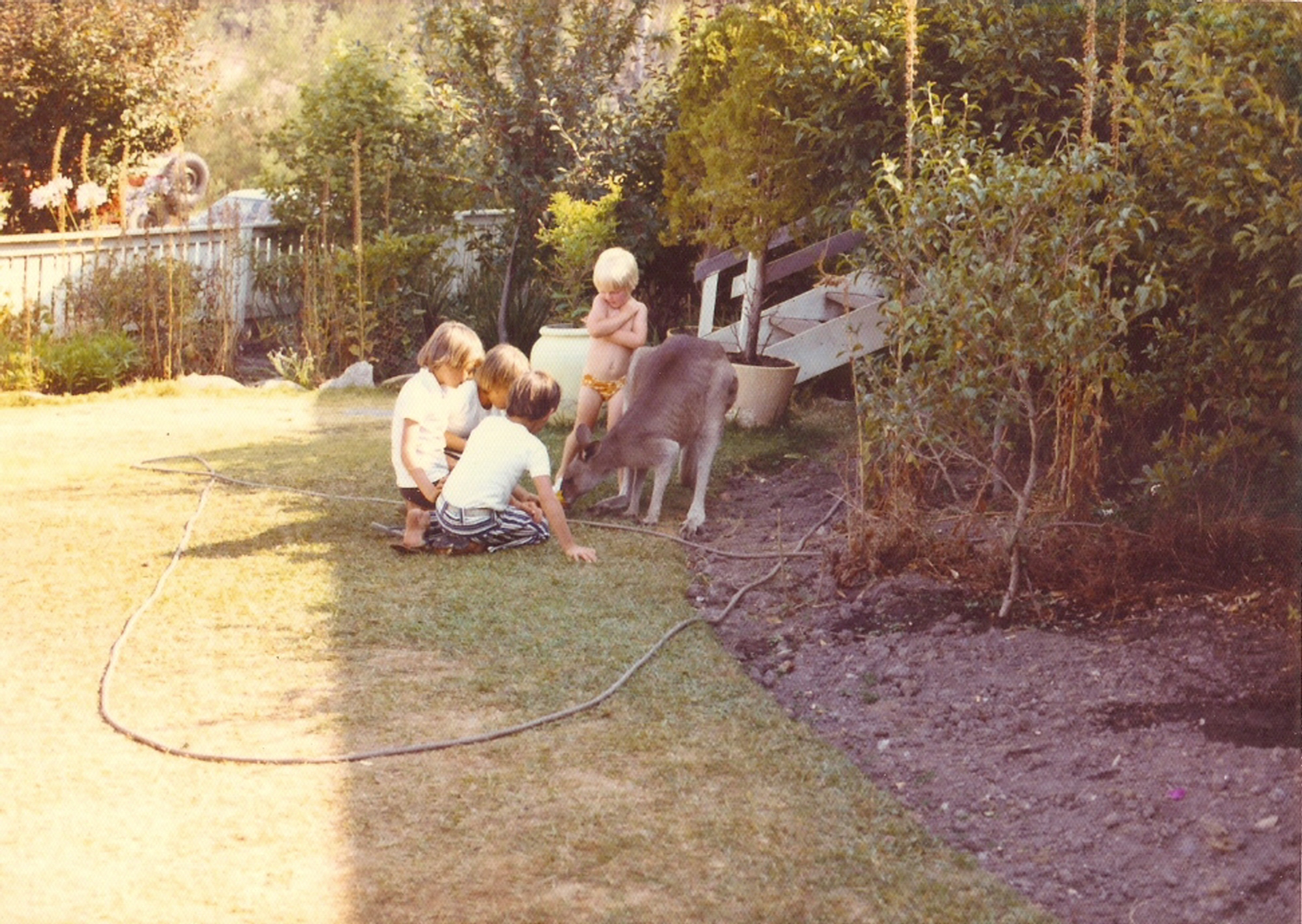
Camping at Malacoota, January 1, 1973.

Camping at Malacoota, January 1, 1973.

Because New Year’s Day falls in the middle of summer in Australia, we decided to go camping on an isolated beach at Malacoota Inlet, halfway between Melbourne and Sidney. The six of us included my sweetheart Felicity and two Aussie Rules footballers who were best mates with my friend Tony Tighe who had recently died on a Mt. Everest expedition. Although “Yank” was a bad word in Australia because of the recent Vietnam massacres, the mutual friendship made me more than acceptable to those who had not seen Tony since High School. I had been good friends with him in Leysin, Switzerland the winter before the expedition. Tony had been with me when I broke my leg skiing and I was with Tony and Jilly when she broke her leg skiing. I also had loaned them my Triumph 250 to go to Spain for Jilly’s recovery for a few weeks before Tony left for Tibet and Jilly went back to Australia. So I was well welded into an Australian mate-ship, one of the strongest personal bonds in the history of humanity.

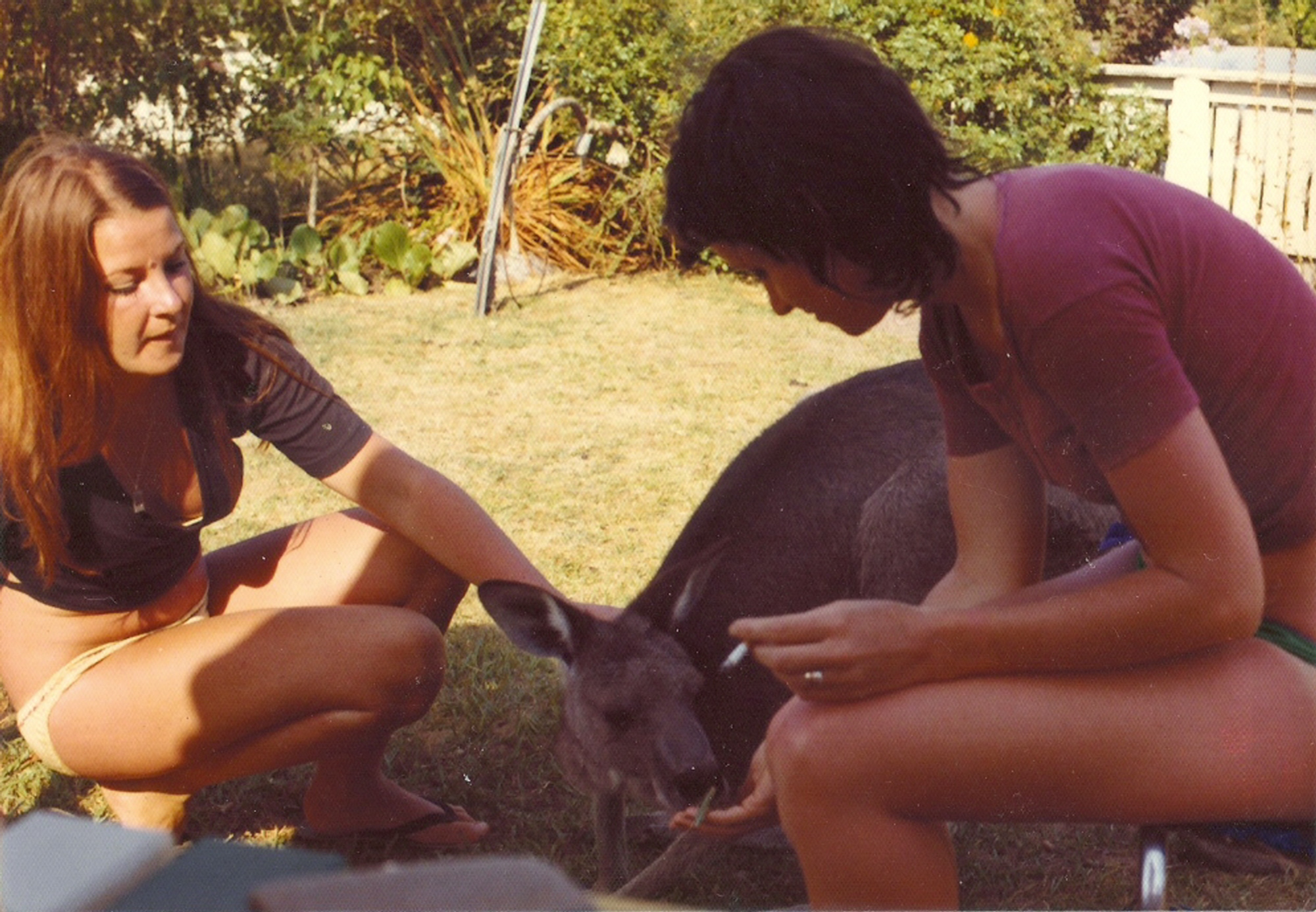
A regular appears.

A regular appears.

There wasn’t much to the town of Malacoota on January 1st of 1973: a campground and a combination milk bar (the Aussie word for grocery store), a gas station and a pub – all in one building. So when we went for beer, there was only one place to go. And on the holiday, the take-out store was closed so we had to sit on the lawn of the mostly outdoor pub if we wanted to rip into an ice cold tube.

A bit of salad for a starter.

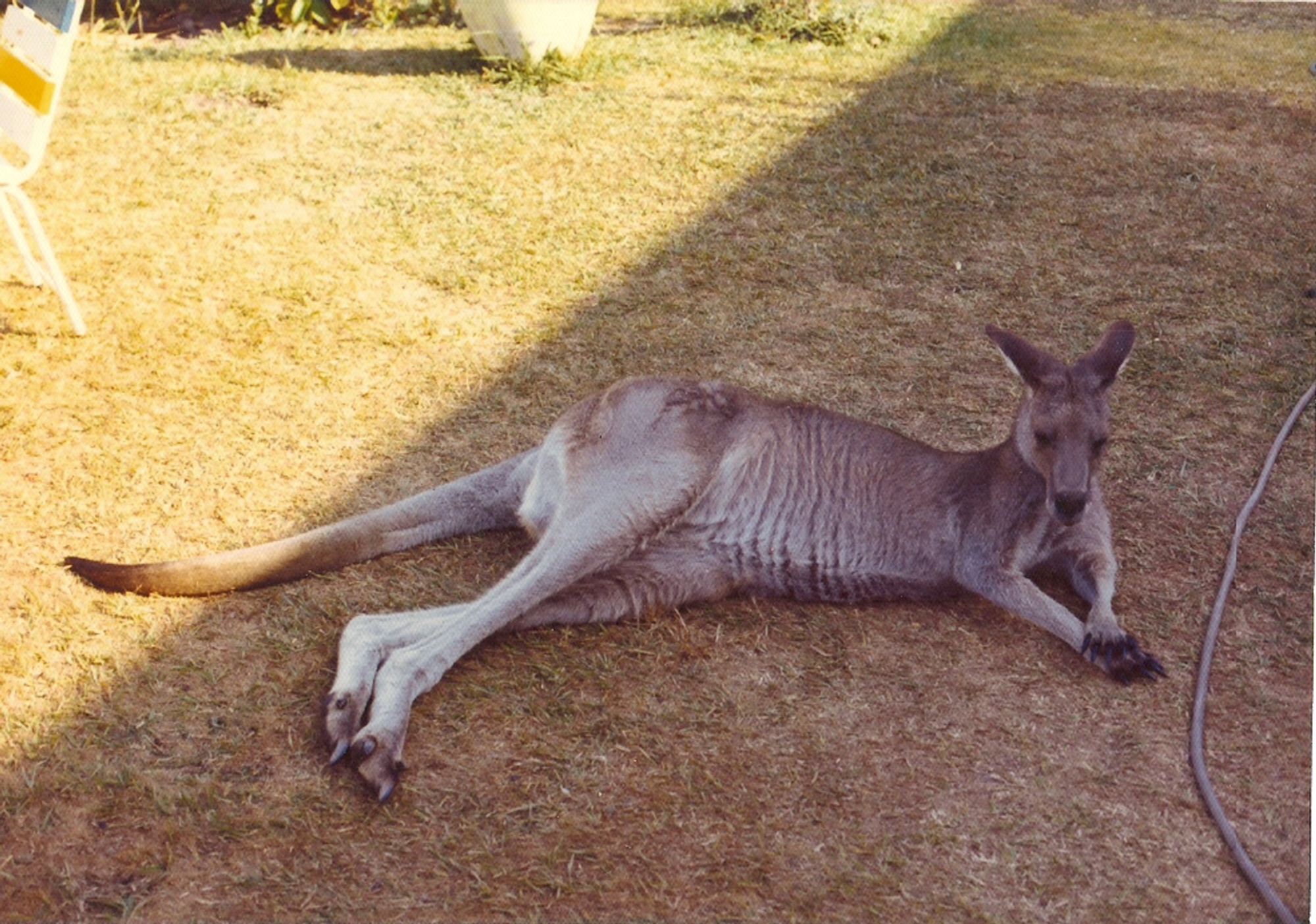
While we were cooling off in the hot afternoon, a well-know visitor to the Malacootans, but unbeknownst to us, hopped in for a look around – a nameless kangaroo that frequented

Peanuts? I love ’em.

the pub but never once paid for a drink. Although that was normally an unforgivable sin during those years, the locals easily forgave the animal because it was not qualified for the dole – the Aussie version of welfare.


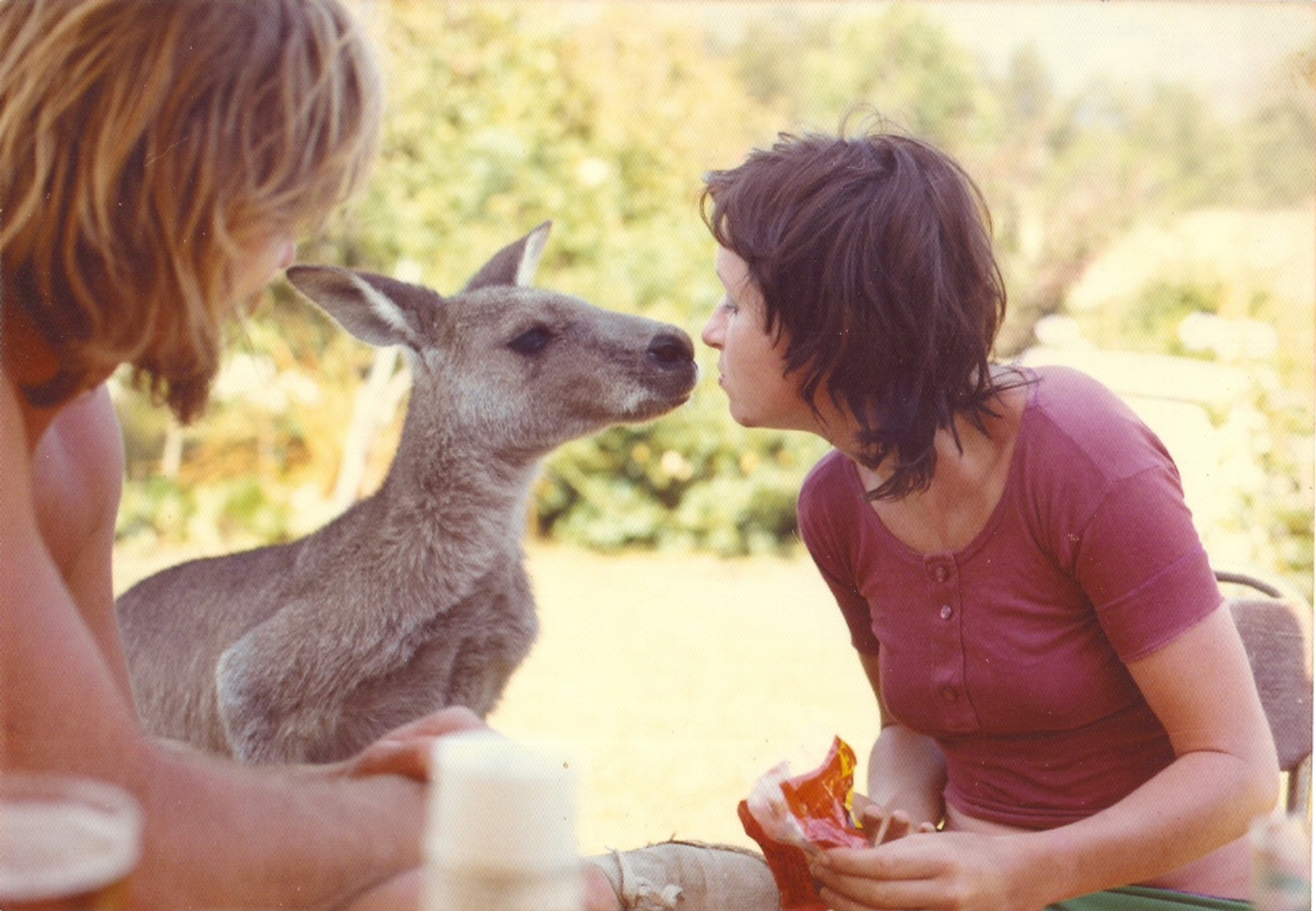
Kiss me. I promise I’ll love you forever.

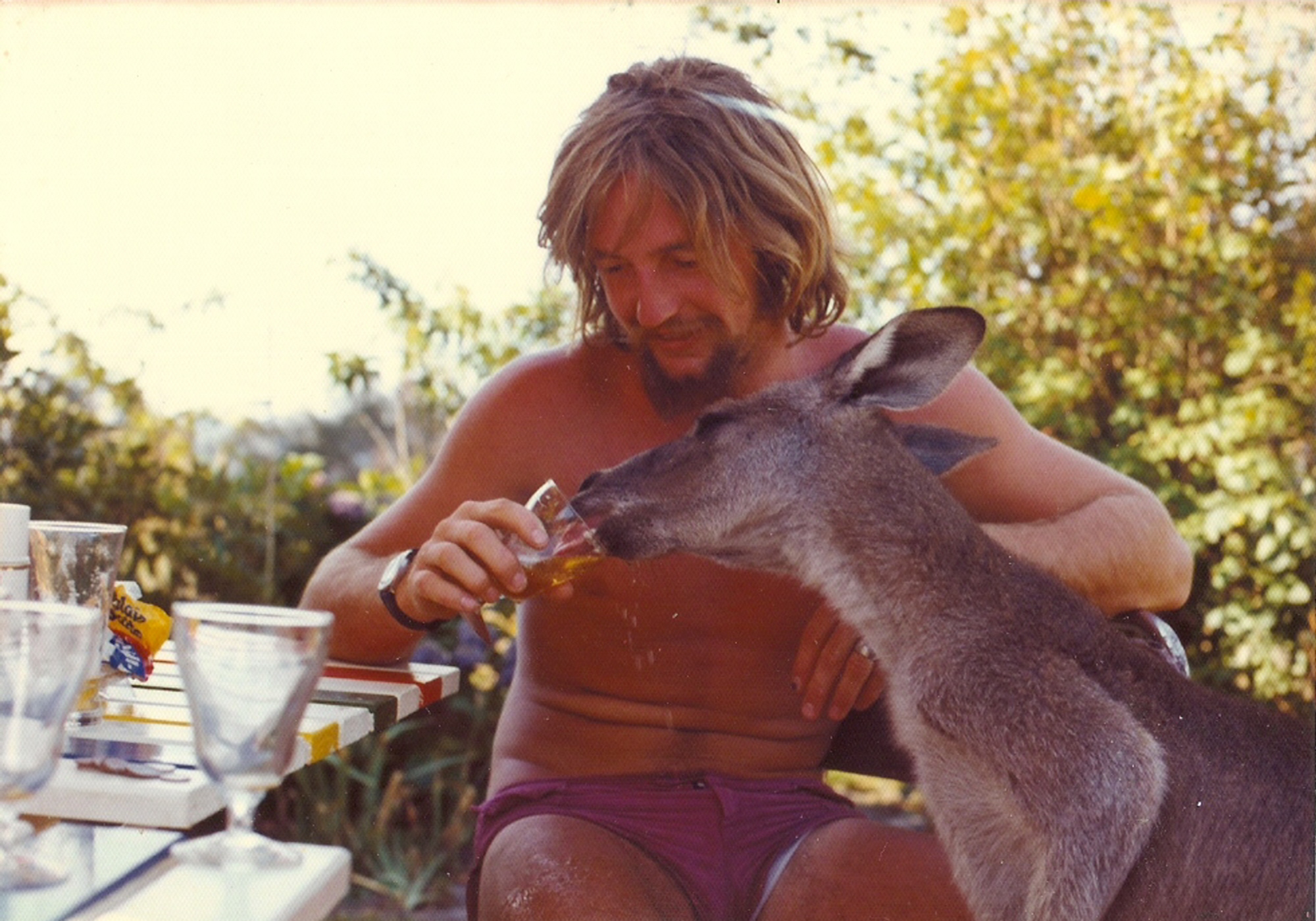
The roo started by paying a visit to the kids to earn his keep. Then he had a bit of salad-grass, and went on to mooch some peanuts, which gave him a bit of a thirst. And like all good Aussies, Rick Brown offered the down and  outer a bit of the amber fluid, which it quickly lapped up.

Then, slightly pissed (Aussie for “drunk,” not “angry”) it tried to kiss every Sheila in the joint. Drowsy from all the excitement, it settled down for a quick nap with both sets of legs crossed before hopping away without saying “goodbye.”

Rick and roo.

Have a drink, Mate.

Have a drink, Mate.

A nap before an uneventful farewell.
H A NapRick had a friend at the Australasian Post, and they published the photo “Rick and roo” in the March, 1973 issue. I carried a copy for years, but finally lost it in one of my many moves. I’ve searched for it online, but to no avail. But I still have the original copy of the photo that I took with my Canon F-1 that I’d scored in the duty-free store when I left Tehran.

Kangaroo drinking beer.

Saidullah’s New House

Most of the work for the field engineers in Bangladesh was in the smaller towns. But we did our planning in Suite 500 of the Intercontinental Hotel in Dacca. In 1970, it was the only hotel in this city of 12 million that had modern facilities. All the rickshaw and taxi drivers knew it as “the air conditioned hotel.” In the mornings as we had coffee and breakfast, our full-time drivers would come in for their assignments, often to spend weeks away from their homes and families. None of them lived in the neighborhood, and all had to come by rickshaw, as we kept our vehicles overnight in the security of the hotel.

One Monday morning, a driver named Saidullah came into the office with tears streaming down his face, making his appearance much less comical than usual. He reminded us of the black-and-white cartoon characters of the 30s, with flexible tubes for arms and legs that flowed rhythmically as he sauntered along, with bright, shining eyes and a happy face –his background music the same as the character from Edgar Bergen and Charlie McCarthy, Mortimer Snerd,“De-doomp-de-doodely-doomp-de-doomp.” His huge nose gave him the appearance of a buzzard, and his stiff, unkempt hair made a slight rooster-crown. He was about 40 years old.

“What’s wrong, Saidullah?” asked Maurice (Andy) Anderson, the boss.

“Oh, sahib, terrible, terrible thing happen,” he sobbed bitterly. “Cyclone come and blow away my house. My wife and 13 children have no place to live.”

We were all well aware of the overpopulation problem of the nation, caused by the same source of all the world’s problems: the greedy leadership cult that uses religion to manipulate the population to hog everything for themselves. In what was then called “East Pakistan,” the people were told that children were gifts from God, and the more they had the more holy they would be. “Never mind educating them. Just put them to work in the fields. We’ll give the crops to God and tell Him how wonderful you are, and then He’ll reward by sending you all to Heaven when you die.” It worked because there was no education system to tell them different.

So after letting Saidullah’s situation sink in, Andy asked, “Is there anything we can do to help?”

“Oh, yes, yes, sahib. Loan me $30 and let me have three days off so I can build a new house.”
That took us all by surprise, so Andy had to ponder a while. Then he reached into his wallet, gave him a $100 bill and said, “Take the week off, Saidullah, and don’t worry about paying it back. We’ll use one of the other drivers while you’re gone. Don’t worry about a thing. Just get that house built.” Andy had to escort him to the door to stop his bows, praises and handshakes of gratitude.

Andy was a true leader… a real American. He had actually believed John Wayne, Roy Rogers and Lassie when he was a kid, not like the fake leaders at the helm in the Tonkin Gulf… not like the ones in the Beltway or the ones I would meet later in Iran. Andy knew that leadership required Courage, Truth, Honor, Compassion and Justice. I liked Andy and I liked the project, even though we were in the so-called “worst place in the world.” But the very week that Saidullah was away, my idealism would be put to the test.

The first microwave telecommunications site outside of Dacca was 20 miles away, but it took three hours to get there because of the two ferry boats we needed to take to cross the rivers that flowed into the Ganges. On Saidullah Monday, we arrived there well after lunch with plans to camp a few nights. We had turned on the equipment week before, and while in Dacca for the weekend, we’d connected the local TV channel to it so now it would be available over the system as we advanced further into the country. Anxious to see how it would work, we put a TV set high on the wall in the yet-to-be-furnished outer office, and left the door open so the locals could come in and watch, most of them for the very first time in their lives.

The room filled within an hour and was a basic sea of lost humanity, all wearing scraps and rags with nothing to do, nowhere to go and no pockets to put any of the possessions nobody had. They stared mindlessly at the TV with open mouths and vacant eyes, some supporting those too weak from lack of food to stand. We watched them occasionally through the high windows in the equipment room, as if we were the TV set looking back at them. At ten o’clock in the evening, the signal went off and the screen filled with snow, with static coming out the speakers. But the crowd remained, motionless, staring at the noise, mouths still agape. Danny Daniel, the senior technician on the project who had been there for several months, went out and turned off the TV. It took a few moments for the walking dead to understand what had happened. Then they slowly dropped their gaze in unison, turned and mechanically shuffled out the door. My mind went back to the Tonkin Gulf. Perhaps burning them all with napalm would not be that much of a sin after all. They were totally useless. I was ashamed that I had considered it, but it seemed like a logical conclusion at the time. But it haunted me for the rest of the week, until the following Monday morning in the office suite when Saidullah would return to change my thoughts forever.

He sauntered into the suite with a more cheerful melody than ever before. The room was alive with the sound of Saidullah. Everyone received lavish handshakes, along with an invitation to his house-warming party to eat chicken tikka, a dish his wife would prepare for the lot of us, using a small portion of the vast amount of money left over. We all anticipated what it would be like to delve that deep into the poverty, but none of us even thought of saying, “No.” I believe curiosity and a genuine concern for Saidullah had the best of us.

We arrived well before sunset to see the bamboo and wicker one-room house made with Saidullah’s  limited time and resources, standing in a small field with crops growing nearby. But before we could see the details, a wave of shining eyes and white and gold teeth came over us, smiling and cheering the heroes who had come at last… wire and children of 14 distinctly different heights. His wife was a tiny thing with wide, brown eyes highlighting a pretty young face that showed little wear from the labors of her womb; the natural result, I assumed, of a natural but limited diet. She was called “Parna,” as I remember, meaning a feather or a leaf. She wore the traditional colorful but well-faded shawl and long skirt, with a red dot on her forehead and a tiny brass adornment in the left side of her nose. The children came to us for hugs, their clothing ranging from earth-stained t-shirts, shorts or skirts… to nothing at all. Footwear was limited to shower clogs or bare feet. All were clean from their daily baths in the large pond behind the house. Soap was a luxury, but a smooth pebble would do the trick. Everything smelled a bit like fresh mud.

The house was built on a three-inch-high, packed dirt platform to keep the water from running in during the torrential rains. Thick bamboo poles supported the corrugated, galvanized steel roofing sheets, woven grass mats covered the walls, and everything was tied in place with strips of bark, now dried steel-hard to last until the next cyclone. Newspaper clippings in glass-less frames provided most of the wall decorations, but a particular couple from past history appeared in a more elaborate frame, their faces sketched anew by a local artist from instructions from the memory of a long-lost photograph. One corner of the house was stacked with rolled-up grass mats and pillows for sleeping. I wondered if they would all fit inside the small room, but then I thought more of sleeping puppies, warmed and secured by the bond of love. The amount of available space would be moot.

The children quickly lost interest in the heroes and soon returned to their usual interests. There were no toys or TV, but sticks, leaves, pebbles and insects – now taking priority over the white-skinned aliens –   would provide all the entertainment necessary. Like all children, there was no need to be running and laughing. But there was always a reason; perhaps only because life itself was a joy, regardless of the frills.

The lack of a dining room suite pushed my mind to one of the first lessons Danny had given me on my arrival several weeks earlier: how to hunker. “Drop to a deep knee-bend and relax. Your butt has to almost touch the ground, but keep your back straight and learn to balance yourself with your arms out front. You’ll need to stretch some muscles to get used to it, but you’ll be able to use the ground for a table anywhere you go. Rest your elbows on your knees.” It had taken quite a few practice sessions to do it, but I could now hunker with the best. I remembered once seeing a hunkering man shaving another using a single-edge razor blade with no handle; a make-shift barbershop with no chair.

At last Parna announced dinner and served each of us one piece of red, crispy chicken tikka along with a pile of rice, well dotted with various vegetable bits, served on a torn off section of banana leaf.  We ate with our fingers, hunkering to form a circle. Highly sweetened tea served in small glasses softened the burn of the spices.

As the sun began to set, Parna began unrolling the mats, calling the children to bedtime, all of whom responded with the usually complaints: “It’s too early,” “the sun’s still up,” “we can still see,” “we’ll wake up on time…” We left as she gathered her precious treasures for sleep.

On the way back to the air-conditioned hotel, I realized that the life of all persons is important. No one has a right to judge the lifestyles of others, and no one has any right at all to decide who may live or die. And particularly, no one has a right to kill massive amounts of people just because they appear distasteful. Those in the TV room had just as much right to live as I did, and my purpose there was to install an educational TV system that would hopefully get them out of the poverty in which they lived. I never again even pondered the idea that mass murder could be a solution to economic or cultural differences.

The Other War with Iran. Chapter 2, The Meshkinshar Problem

The next morning, Mr. Shababian and I headed for Meshkinshar to find out why the construction of a 200-foot tower needed to support a 10-foot diameter microwave dish had mysteriously stopped. The location was the small telephone switching building that routed telephone calls to their destinations. The microwave radio system would replace the antiquated long-distance lines that suffered frequent service interruptions, with sound quality so poor it was hardly worth using. The new system would carry high-quality, long-distance telephone service along with two television channels.

The tower needed four foundations: one for the tower itself and three more to anchor the guy wires that would support it. Each foundation needed holes dug and filled with concrete to support their respective loads. When we first arrived at the site, we could see the parked back hoe and tower sections already assembled and ready for lifting into place. The microwave dish was also assembled and waiting for the tower. As we walked around the area, we noticed the three excavated holes, with the remaining spot marked with sticks holding color-coded ribbons fluttering in the arid breeze. The back hoe seemed poised and ready, like a hungry dinosaur, but with no Fred Flintstone to operate it. Mr. Chief Engineer Shababian seemed to be absorbing more information than me, as he had his hand on his chin and kept muttering “Hmm, hmm,” followed with, “Let’s take a look inside.”

As we entered the building, the two surprised men who’d been playing cards and drinking tea leaped to their feet and gave Mr. Shababian a lavish greeting with bows, handshakes and smiles. They obviously knew who he was. The worried looks on their faces suggested to me that they could possibly be in trouble, but after a quick statement that I didn’t understand from Mr. Shababian, they went back to their game. He motioned for me to join him back outside.

It was flat and arid land, but because of an elaborate and ancient irrigation system, there were crops growing all around, and even some within the site’s perimeter chain-link fence. Mr. Shababian spent another five minutes ambling around the area, then came up to me and asked, “Do you have a plot plan for this site?” It was a large drawing showing the relationship of all objects in the area, existing and proposed.

“Yes, I do.” That was the one bit of support the company had given me.

“Well let’s have a look at it.” We found a table back inside and spread out the drawing. Mr. Shababian looked at it for several minutes, and finally asked me, “Can you see any reason why we can’t rotate the tower ten degrees clockwise?”

“What?” His question took me completely by surprise.

He held his hands flat above the drawing, forming a triangle between his thumbs and forefingers and placing them over the planned location of the tower. Then he turned his hands clockwise showing his proposed position of the tower. The center would be in the same place, but the anchors would have to be relocated. “I’m just wondering if this change would cause any technical problems from your department’s point of view.”

“Why on Earth would you want to do that?”

“Never mind that for now. I just want to know if we could do it without causing any other problems.”

I looked at the drawing for a few minutes and said, “Well I don’t see any reason why not. Usually we try to have one of the guy wires pointing north for a reference, but it’s not absolutely necessary. It’s not an engineering requirement.”

“Well let’s try it on paper to see if it works.”

We used colored pencils and a ruler to illustrate the proposed location superimposed over the old, developing what’s called “a red-line” drawing used to plan and authorize engineering changes. When we finished, we saw no new problems. “OK, let’s do it,” he said. When you get back to Tehran, tell your people to send the surveyors to mark the new locations of the anchor holes. Then the back hoe operator can fill in the two old anchor holes and dig the three new ones. After that, you can continue as if nothing happened.”

Officially, such changes needed to be recorded and sent through an approval process. But being the chief engineer, he had the final say on all change orders. He signed the drawing, rolled it up and handed it to me. “Here, tell them you have an authorized change order, signed by Mr. Shababian.” We both chuckled at him mocking his own name.”

“OK, but… why? Why are we rotating the tower?” I was totally confused.

“I’ll explain on the way back. Come on. Let’s go. We’re finished here.”

In the car, Mr. Shababian told me the story. “You saw the two men playing cards and drinking tea? Well one was the telephone technician who works there and the other was the back hoe operator. So let me tell you how I’m guessing it went. The back hoe driver arrives and the telephone man greets him. ‘Praise Allah, at last you are here to dig the holes. I’ve heard about the tower that He is sending us.’

‘Praise Allah, and thanks to Him, we will soon have a modern system.’

“The operator goes out to dig the holes. But did you notice anything strange about that third hole, the one yet to be dug?”

“No, not necessarily.”

“Well it was right, smack in the middle of his vegetable garden. So the operator tells the technician, ‘Praise Allah, we have a problem.’

‘Good heavens, what is the problem?’

‘One of the holes would destroy your vegetable garden! Praise Allah, what shall we do?’

‘Could we wait until Allah finishes making the vegetables grow?’

‘I believe that would please Him. But what can we do in the meantime?’

‘We can play cards and drink tea. It will only be another month or so. You can stay here with me until the vegetables are ready to pick.’

‘Can you send someone to tell my family I’ll be staying here with you?’

‘Of course, praise Allah.’

“It’s perfectly normal for the people out here in the country to act that way,” Mr. Shababian concluded. “No one’s in a hurry for anything.”

“Why couldn’t we just give him fifty bucks for the vegetables and get on with it?” I asked.

He spoke slowly as he shook his head. “The vegetables are gifts from God. Fifty bucks would be a gift from man. He would definitely refuse the offer.”

“Couldn’t you force him take the money? After all, you’re the boss.”

“I could never do that. It would break his heart. Those vegetables are far too important to him. Besides, the telecommunications system is meant to help the people, not to destroy vegetable gardens.”

“But they looked disappointed when we left.”

He laughed out loud. “Well, yes. They were looking forward to continuing their card games. But they’ll soon realize that the change is Allah’s will and they’ll praise him again before they go about their business.”

“I think I’m beginning to see.” I felt more comfortable as I was getting a better feel of what rural Iran was really like; peaceful, considerate and compassionate.

We still had a few hours for the return trip so I thought I would get as much information from him as I could. “Tell me more about the mistakes we’re making here?”

“Well most of them have to do with your hurry to get things done and your refusal to show even the slightest respect for our culture.”

“Can you give me an example, other than the bazaar?”

“Let me tell you two stories. Mind you, these didn’t actually happen, but they’re examples of the kinds of things that do happen. Let’s say an American comes out here to sell pickup trucks to the old-fashioned farmers. He sees an old man riding a donkey, stops and says, ‘Hello, old man.’

The old man says, ‘Praise Allah, a visitor from afar. And why has He sent you to me?’

‘Ah, good sir, Allah has sent a pickup truck that you may wish to purchase.’

‘Praise Allah, what is a pickup truck?’

‘Why, this marvelous machine I am riding in is a pickup truck. Would you like to get in and see what it’s like?’

‘Of course, praise Allah. It certainly is beautiful. What makes it run?’

‘It burns gasoline. We make it from the oil we dig out of the ground.’

‘You mean to tell me that you dig that nasty oil out of the ground and then burn it in this machine?’
‘Well… yes.’

‘Well, I’m not sure Allah would like that. He buried that oil down so deep because it is so foul. We should not be digging it up when we have perfectly good donkeys to ride on. They have been given to us by Allah.’ Then he might ask, ‘What does your pickup truck excrete?’

‘Well, it excretes gases that disappear into the air.’

‘And can you show me its anal opening?’

The salesman then shows the old man the exhaust pipe. You see, when the farmer buys a donkey, he sniffs its butt-hole to make sure it is healthy. So the old man takes a sniff of the exhaust pipe. ‘Phew, that smells horrible. I don’t think this machine is very healthy. I don’t think I would like to buy it today, sir. But please go in peace, and may Allah bless you.’”

“But I’ve seen quite a few pickup trucks around.”

“Well of course, but not everyone wants them, at least not yet. You see, our society is divided between the old and the new cultures. The old is still the majority, and they’re very set in their ways. But I’m sure they’ll adapt and we’ll join the modern world eventually, but we can’t do it tomorrow. We have to take our time. Forcing people to change only causes problems. But let me tell you the next story.”

“Go on, this should be good.”

“A television salesman knocks on the door of a small home in the country, like the ones you see all around you now. The man of the house answers the door. ‘Praise Allah, a visitor from a distant land. And why has Allah sent you to us.’

‘Well, good sir, Allah has sent me with a television set.’

‘A television set? Praise Allah, what on earth is that?’

‘It’s a magic box that shows moving pictures with voices and music from all over the world. You can use it to see your King and your holy men. You can see football games and you can use it educate your children. Do you think you would like to have one?’

‘Praise Allah, I believe I would love to have one.’

‘Well I just happen to have one in my truck.’

‘Well, bring it in, by all means.’

So the salesman brings it into the house and asks, ‘Where shall I put it.’ The man of the house holds his chin in deep thought. He can’t think of a place. So the the salesman says, ‘Why not put it in that corner over there?’

‘Oh no, no, no! That corner is very sacred. That is where great, great, great, great grandfather had a heart attack, but thanks to Allah, his life was spared. That corner is very sacred and we could not put the television there!’

‘Well, how about that other corner over there?’

‘Oh no, no, no! That corner is also very sacred also. That is where great, great, great, great grandmother had a premature childbirth, but thanks to Allah the baby’s life was spared. That corner is very sacred. We could not put the television there!’

Soon the salesman finds out that every part of the house is sacred for one miracle or another that happened over the course of the centuries. But not to despair, the man of the house soon comes up with an idea. With a bright smile he says, ‘See all the little children in the house? We will tell them about the television as they grow. And when they are grown up and my son is the man of the house, he will have decided a place where you can put the television. So would you mind bringing it back in fifteen years?’”

“That’s hard to believe.”

“Well,” Mr. Shababian said chuckling. “It may be a bit of an exaggeration, but you should get the point. You could probably negotiate the television set in a few months, but you would have to take your time and be very patient and polite. Family heritage and courtesy are very important to Iranians. But getting things right now isn’t, as you’ve already seen.”

“I’m getting a better picture.”

“And you know what I think the American truck and TV salesmen would say about our people?”

“What’s that?”

“They’d say, ‘They’re contrary to American economic interests and are therefore our enemies.’” He seemed to let out a sigh of knowing disappointment. “They’d be offended and angry.”

“Well wouldn’t they have a right to be? They’re not going to get anything done.”

He looked at me directly in the eyes as before, “If you Americans have the right to advance as rapidly as you wish, why shouldn’t the people of Iran have the right to advance as slowly as they want? You’re always talking about freedom, but when it comes to profit, freedom seems to be reserved only for the profiteers. The people in Iran don’t want you to do what you did to your own Indians. We simply want to progress at our own pace, regardless of your profit projections. Peace means far more to us than money.”

As there wasn’t much I could say to that, I chose to watch the desert landscape go by for a few minutes. I then asked Mr. Shababian if he knew where our field office was in Tabriz. He said he did, and that we could stop there before going to the airport. We had a short wave radio and I wanted to contact Tehran to report that the problem was solved.
After several attempts, the radio operator in the Tabriz field office finally managed to make radio contact with our civil construction manager in Tehran. I explained that the problem with Meshkinshar could be solved by rotating the tower ten degrees clockwise. His obviously confused voice asked, “What the hell is going on up there?”

I said, “Well, I’ve been to the site with Mr. Shababian and he wants to rotate the tower ten degrees clockwise.”

“Why the hell does he want to do that?”

I knew he wouldn’t understand, so I just said, “I don’t know but he’s already approved a red-line drawing. I’ll complete the change order paperwork when…”

He interrupted with, “Bullshit, Asmus! You tell that fucking son-of-a-bitch to kiss your ass! You’re not making any changes without authorization from this office!”

Mr. Shababian was standing right behind me and heard every word. I said into the microphone, “I’m sorry, you’re breaking up. I can’t hear you.”

The squawking voice went into a rage. “That mother fucker is the cause of all our god damn problems. You tell that stupid shit that you’re not changing anything without my approval. Tell him to go fuck himself.”

“I’m sorry, I can’t hear you. You’re breaking up!” Mr. Shababian and I held our hands over our mouths and laughed without making a sound. I continued talking into the microphone, explaining very slowly and clearly, “Richard Asmus, calling from Tabriz! Meshkinshar tower problem solved! Rotating tower ten degrees clockwise! Will report to office tomorrow with a red-line drawing signed by Mr. Shababian! Over and out!” The rage continued on the speaker as we left the room laughing.

On arriving to work the next morning I was instantly summoned to a meeting room with all the department heads and the general manager of the entire project, a boulder of a man with a bald head, a round red face, a thick black moustache and a stubby cigar lodged permanently in the corner of his mouth. He barked out the other corner, “Will somebody please tell me just what the fuck is going on here?”

The construction department head leapt to his feet, sneering through his pencil thin moustache. “Fucking Asmus here is not the man to be sending out with Shababian. He’s letting that asshole push him around. We sent him up to Meshkinshar to find out why the tower construction has stopped, but Shababian comes up with some bullshit idea about rotating the tower. Fucking Asmus falls for it and signs a red-line without even asking us.”

My boss then immediately rose. He was a short and stocky man with thick blond curly hair, ice-blue eyes and a slower and more confident manner. “Now wait just a fucking minute here. We send Asmus up to Meshkinshar with Shababian to find out why construction has stopped, and he comes back, not only with a solution, but with a change order already signed by the top dog. We can resume construction as soon as we do a new survey. What the fuck more do you want? Asshole, here, sent two of his morons up there and they came back with nothing… absolutely nothing! Further, everyone else has problems just talking with Shababian. Asmus seems to know how to get him to sign change orders.”

From around the cigar came, “Well it sounds to me like somebody’s finally got a handle on that shit bag. How’d you do it, Asmus?”

“Well, Sir, I just learned how to pronounce his name properly.” The blank faces showed me I needed to explain further. “I think if we’d all start addressing him properly, we could make some great inroads. His real name is not Mr. Shababian. It’s Agha Mohahndess Shahbabian. It means, ‘Mr. Engineer Shababian,” and it shows the respect of his position. And if we all learn to call him that, I think we’ll see a different man. Calling him ‘Mr. Shababian’ is the way we address a person without a profession, like a driver or a garbage man. ”

The blank faces remained frozen. “Let me show you how to do it.” I felt like a clown, but I went through the motions that he had taught me, thinking that they would follow. But as I continued, the puzzled faces didn’t budge.

Suddenly the silence broke from the other side of the cigar, “What the fuck are you talking about, Asmus. Fuck that camel jockey son-of-a-bitch. We’re not gonna kiss his ass. Now get the hell out of here. Oh, by the way, nice work! We’ll send you on more jobs with him if you think you can handle his bullshit.”

“Piece of cake,” I said while mentally rolling my eyes back.

Click here for Chapter 3

2015 © copyright The Other Third World

A Brief History of The Third World

Shortly after WWII, the surviving superpowers began salivating over how to rule the entire world. The United States and Western Europe formed the First World, and developed a monetary system in which people were free to fight each other over the pursuit of happiness. The financially astute could acquire opulent wealth and the rest could just go eat dust. Although it was officially called “capitalism,” it didn’t sound too good, so they changed it to “The Free World…” even though it was quite expensive. To manifest their dream, the wettest capitalist jowls began gobbling up corporations, newspapers and politicians.

Russia and Eastern Europe formed the Second World and wanted people to struggle for the common good of their community. Those who could spout the best altruistic diatribe could become wealthy, and the rest must survive on whatever leftover scraps were dished out. Ideally, the system would have been named “Community-ism,” but the opponents changed it to “The Communist Block” to make it sound icky and ominous. To manifest their dream, the wettest communist jowls began a massive slaughter of their opponents within their countries.

Neither side had the courage, the intelligence, the honesty or the decency to seek peaceful solutions to their differences. So they isolated themselves with moronic metaphors like the “Iron Curtain,” “Godless Communists” and “Capitalist Pigs.” They produced vast amounts of heinous weapons – enough to destroy the entire planet thousands of times over – all at the expense of their respective populations, but for the financial benefit of the sniveling snots who had the audacity to call themselves “leaders.”

Most smaller nations could see through the nonsense and only wanted to be left alone. But the mega morons began relentless, elaborate scams and destructive, debilitating wars to suck them into their systems. To make their victims sound inferior, they labeled them “The Third World,” even though they comprised 70% of the planet’s population.

The spitting and snarling between communist and capitalist lasted for several decades. But finally, a communist demagogue with a funny red mark on his forehead told a capitalist demagogue with Alzheimer’s disease, “I’m gonna fix your ass! I’m gonna give up! You’ll no longer be able to screw your people by pretending to defend them from me.”

The capitalist with Alzheimer’s responded by going on worldwide TV and telling the communist to “tear down the wall,” a ritual the communist had already planned. The argument over who actually ended the cold war remains as spitty and snarly as the conflict itself.

Today, the first and second worlds have joined together to form a globalized market to take over the entire planet by lying to everyone about everything. “Buy this and you’ll be fine,” rants the 30%, then goes on to feverishly gobble up 90% or the world’s resources. The remaining 70% must eke out a meager living from whatever slim pickings are left. But what the mega marketing morons don’t understand is that minimizing consumption can be every bit as enjoyable as maximizing… if not more. So how do the majority of the poor people in The Third World manage to survive against these odds? Simple. By loving life instead of stuff.

Come join the party!

2015 © copyright The Other Third World

The Other War with Iran. Chapter 1, Indoctrination and Mr. Shababian

Part 1, “If you hit a child with your vehicle, don’t stop.”
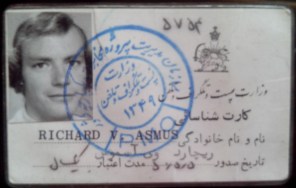
iran-id-2

Legal Resident of Iran, 1971

When I arrived in Tehran, I had no trouble getting through customs and immigration. I’d been issued a resident visa and work permit at the Iranian Embassy in Munich, a relatively simple process. Everyone in the entire world knew that the Shah of Iran was a personal friend of the United States of America and everything it stood for, thanks to the accurate and honest reporting of the mainstream media. He was a man of equal stature to George Washington and Abraham Lincoln, a pillar of peace, honesty and justice. There should be no problems in his country. I was excited to get a first hand look.

As I left the immigration and customs area, I saw a driver holding a placard showing the names of the arriving employees, exactly as I had been told. Two German engineers whom I’d met at the interviews in Munich were waiting along with him, and we greeted as if we were old friends. We soon arrived at a clean and modestly furnished three-star hotel, filled mostly with employees of Page Communications Engineers, the Washington DC engineering firm responsible for designing the new telecommunications system for the entire nation of Iran. After helping us check in, the driver informed us that the next morning, he would take us to our indoctrination lecture. I slept soundly in the comfortable but simple hotel, not noticing any radical differences from any other hotel I had ever slept in.

Breakfast included pita bread filled with yogurt and what the locals called “eating greens,” that I guessed to be parsley, mint and green onions – a bit different but quite tasty, actually. About six other new Page employees joined, and we all got to know each other via typical small talk. The van and driver returned at 8:00 am sharp and took us to the human resources building for the new employee administrative processes, just like anywhere in the world. We were later invited to a simple lunch of submarine sandwiches at an Iranian deli that could have been in New York City. We then all piled back into the van to go to the indoctrination lecture, and to the first darkening of our fluffy clouds.

We were first informed that Iran was in a very steep section of an uphill development curve, and the population was divided between the new culture wearing typical Western clothing, and the old traditional culture wearing the ancient apparel, with both sides accepting each other in peaceful harmony. In Tehran, we would see mostly the new, but outside of the metropolitan area, we would see mostly the old. And that’s where our first danger would arise.

Almost all highways were two-lane and crowded with pedestrian traffic, creating a dangerous situation that caused many accidents. Although the company would try to provide us with Iranian drivers for enhanced safety, we would be allowed to drive the company vehicles ourselves when drivers weren’t available. But in the unfortunate incident that we hit a pedestrian, and particularly if it were a child, we should not stop, but instead head for the nearest border as fast as possible and get out of the country. If we stopped, a crowd of horrendously evil people would gather and probably chop us to pieces. What, I thought. Americans wouldn’t do that. Americans couldn’t do that. We would have to stop. There’s no question about it. Just ask John Wayne, Roy Rogers or Lassie. We respect human life. I took as much stock in their idea as I would a TV commercial, not feeling apprehension, but having far less respect for those at the helm of my new employer. I was unaware that several months later, I would be put to the test.

The second most surprising item in the lecture dealt with personal relationships. Obviously in the coming year we would make friends with the Iranians who were adapting to Western ways. But we should never talk politics. The secret police called “SAVAK” were everywhere, posing as drivers, waiters, bartenders and such, and were listening for political dissent. In short, if the wrong thing was said, and the wrong thing reported, the next day we would find that our residence visas and work permits had mysteriously disappeared. We would be escorted directly to the airport without any chance to pack our bags, and would be banned from any further entry into the country. And we were sternly advised that we should not ask about our Iranian friends, because there would be no record of them ever having existed. My thoughts again went back to the movies. How could America keep such a close friendship with a country that didn’t allow its citizens to speak their minds. I left the lecture thinking, OK, I’ll do my job the best I can. I’ll get my bonus for staying a year, and then I’ll be on my way. I had given my word to stay and therefore I must, or at least that’s what real Americans like John Wayne, Roy Rogers or Lassie would do.

After the lecture, I was escorted to my office in the seven-story building, newly constructed to house our engineering team. When I was shown my desk, there was an Iranian technician hunkering on it installing a telephone, appearing to be working with his hands and feet. He was wearing a brown turban with cloth hanging down the back like a pony tail. When he arose, I noticed that his shirt went down to just above his knees, and his pants were tight around the ankles showing his woven slippers with pointed toes. He looked up at me with a beaming, broad smile that showed several gold teeth and said something I didn’t understand but assumed to mean, “Hello, you’re telephone is now ready.”

I nodded and said, “Thank you,” obviously breaking the language barrier because he seemed to understand. But although he was shabby, soiled and smelled strange, he didn’t seem as foreign as the telephone or the desk. I had come from six months in Bangladesh, followed by a winter of ski bumming in Europe. A desk in an office was more foreign to me than anything I had seen in the past 18 months. And in my five-year career as a telecommunications technician, I had never worked at a desk. I only helped the desk dreamers solve the problems that actually occurred in the functioning world, where reality often trumps elaborate scientific planning.

As I looked around the office, I noticed 11 desk-dwellers whom I soon discovered to be from the US, England, Australia, Germany and Canada. They all had that pleasant and professional here-to-serve-you engineering air about them that I had seen so often. But the idea of joining them suddenly struck me as if I were in a school girls’ dormitory. Surely I could survive and find ways to be congenial, but it was far from my natural habitat. I started asking simple questions about the need to make field trips out to where the action was. Unfortunately, the greatest need was in the design and planning of the system. The engineers claimed that the field people were adequate to report relevant information about problems. I doubted this, but figured that I could drop enough hints that if the need for one of us to go into the field arose, I would be the natural choice. I thought my best strategy was to be a complete nuisance.

My first assignment was to create drawings showing the routing of the wires called “waveguide” that carried microwave signals from the radios to the antennas mounted on the towers. They were actually hollow, oval-shaped copper tubes with an insulating jacket, and must run their entire distance in one piece with no splices. From my experience, the main purpose of these drawings was to ensure that the section of waveguide was long enough, and that it came with all the appropriate mounting hardware. The actual routing details would be established by experienced installers in the field. Exact drawings were not necessary. A rough sketch would do.

But I was informed that the contract required isometric drawings to show all the details of the run, a waste of time in almost everyone’s opinion. But the contractual obligation meant that it was included in the price, and we must do it to justify the inflated amount that the Shah had approved to dole out to his buddies in Washington. Although I had no clue what “isometric” meant, I was sure figuring it out wouldn’t be my greatest problem. Boredom would.

So for entertainment, I began looking around my bizarre environment, noticing several superfluous gadgets: drawers full of rulers, compasses, drawing aids, paper clips, pencils, folders and envelopes; all sorts of office stuff that I’d considered basically useless when real problems arose. I noticed that my telephone number was extension 68. The next higher number leaped into my mind, and I just had to know who was on extension 69! So I eased my swivel chair forward and picked up the phone, slowly dialing the two digits and placing my hand so I could hang up without being noticed. I heard the phone behind me ring, and then heard, “Hello,” both in the phone and from the voice behind.

I waited a comfortable pause, then quietly said, “Fuck you,” through the side of my mouth, then hung up with as little motion as possible. I then tried extension 67, which turned out to be the engineer on my left. I did the same, but this time I could watch his puzzled reaction through the corner of my eye. Laughing inside like a hyena in a coma, I went on with 65, 66, 70 and 71.

Soon came a tea break and I would meet the coworkers I had already successfully annoyed. Tea was served Iranian style, with crystallized sugar cubes to be sucked while sipping the hot tea from little shot glasses. Soon the conversation began. “Someone called me, said ‘Fuck you,’ then hung up.”

Various accents repeated, “Me too!”

I couldn’t hold back the laughter. All heads snapped in my direction. “The new guy!” came in unison. “What’s your story?”

Part 2, Meeting Mr. Shabbian

Engineers from around the globe each have their own unique story. I shrugged and said, “I’m a field engineer. I’m not sure what I’m doing here!” They all understood and took it amicably. They had been told that I was an excellent and supportive field engineer, but wanted to try my hand at the desk, suggesting that this would be some sort of promotion. They assured me that they would help me, and I would soon fit right in. I thought I would do everything in my power to make that not happen, but I would be congenial enough to not lose the job. I really wanted to see this ancient nation and rise above the horse manure shoveled out by the salivating-for-supremacy Western corporate press. Soon our differences became bonds. But after several episodes of crank calls, paper clips shot with rubber bands, pencils and rulers glued to desks and whoopee cushions on chairs, the word around the office soon became, “We need to get him out where he belongs.” Destiny stepped in, just as I was about to be lynched.

I was passing the boss’s office just as he slammed down his phone yelling, “That fucking Shababian!” I stepped into his office.

“What’s wrong, Chuck?” I asked.

“I know that son-of-a-bitch is in his office, but he won’t take my call. And this is important!”

Mr. Shababian was the chief engineer of the project. His boss was the Iranian Minister of Post, Telephones and Telegraphs, who reported directly to the Shah. I understood him to be a major player on the project.

“What’s the problem?” I asked.

“There’s a site up near the Russian border where the tower construction has stopped. The materials have been delivered and three of its foundation holes have been dug and there’s only one hole left. But the backhoe is parked and all the driver does is play cards with the technician. The construction boss has sent two different teams up there, but they couldn’t find out what the problem is.” He tossed some Polaroid snapshots across his desk, which I immediately regarded as irrelevant. I wondered why they hadn’t sent people with brains instead of cameras.

“So why don’t you give me a crack at it?” I suggested.

He looked at me with an ornery smile and said, “Yeah! Good idea! I’ll throw Shababian some fresh meat!” He reached for his phone. “Plan to go on a field trip for a few days.”

Victory, I thought.

So far, I’d heard two versions of Mr. Shababian. From one side, he was a problem: arrogant, uncooperative, non-communicative, irresponsible and unqualified for his job. And, of course, he had dark skin and a funny accent. From the other side he was a genius. He spoke five languages, earned his BSEE at MIT, but also had two graduate degrees in business and comparative religion from prestigious universities in other parts the world. After hearing the conflicting descriptions, I really wanted to meet him. Soon I would get my wish, but not in the manner I had hoped.

I was given travel documents to fly to Tabriz, a city in the northern part of Iran. I was to page Mr. Shababian at the airport and he would arrange a hotel and ground transportation. On the following morning, we would drive to Meshkinshar, a town about four hours away. It all sounded simple enough.

I arrived at the Tabriz airport in the early afternoon and found the rustic paging podium, operated by a professional looking, multi-lingual woman wearing a Western-style business outfit with skirt, white blouse, silken tie and jacket. I asked her to page Mr. Shababian. She spoke into an ancient, Edward R. Murrow microphone and I heard the page and waited, but Mr. Shababian didn’t show up. We paged again and again, but with no luck. I somehow sensed that he was there, but just not answering the page. So I started traipsing around the small airport looking for him, trying to image what he would look like. I had not been shown a photo.

Having no luck inside, I went out to the parking area and spotted a light-green, short-wheel-based Land Rover with the Iranian Project Management Organization’s logo stenciled on the door: a smiling lion holding up a scimitar in one paw, with something scribbled in Farsi above and the letters “PMO” beneath. I went to the driver and asked if he knew Mr. Shababian. He fidgeted nervously, probably not understanding English, but nodded toward the four people seated in the back.

At the still-opened rear door, I saw four men seated on the benches along the sides with two facing the other two. Three of the men looked a lot like me: khaki cotton slacks, plaid sport shirts, penny loafers and a few pens and pencils in pocket protectors. But the fourth man was quite different. He was wearing a crisply tailored, dark business suit, an impeccable white shirt with an elegant tie. From the aura of his handsome, fresh and professional appearance, I assumed he would glow in the dark. I introduced myself generally to all, apologized for not speaking Farsi, then told them, “I’m looking for Mr. Shababian.” The three who looked like me looked down at the floor and began nervously stirring nothing with the toes of their shoes. The fourth man started looking around the ceiling rolling his eyes back, obviously quite bored. No one answered, but I was determined. “Look, I know you’re with the PMO, and I know you know who Mr. Shababian is. Please, we have work to do and I need to find him.”

After a long and nervous pause, the well dressed gentleman collected himself, stretched as far as he could to get his face as close to mine as possible, looked directly into my eyes and slowly and firmly informed me, with an arrogant and mocking tone, “There is no Mr. Shababian. However, there is an Agha… Mo hahn dess… Shah babian. And I… am he!” Then he settled back into his seat.

To me, the problem was instantly clear. I imagined that if I were the chief engineer on a very important project, a project covering a nation of twenty million people, and my correct title was Chief Engineer Kingsley, and not only other engineers, but also technicians, craftsmen and laborers, all of whom were visitors to my country from foreign lands, called me directly to my face, “Mr. Kinky-poo,” mispronouncing my name and never using my correct title, never showing proper respect, I think after a year of this I would also be quite annoyed and, I too, would cop a confrontational attitude, with my toes curling each time I heard my name bastardized. I knew I was directly in the face of my first international diplomatic challenge.

I tried, “It’s nice to meet you sir.” My offer for a handshake went ignored. “Well, I guess we’ll be going to Meshkinshar in the morning.”

“Yes, I’ll meet you there.”

“But, I was told that we would go together.”

“My specific instructions were to meet at the site,” he snapped.

“But sir, I don’t know where it is!”

He leaned again into my face. “You mean to tell me that your company sent you this far out into our country without giving you the directions of how to get where you’re going?”

“Well, I guess so,” I replied, meekly.

“That’s not my problem.” He muttered something to the driver that I didn’t understand, pulled the door shut and they left.

I hailed a cab and got the driver to follow him. After a short and uneventful pursuit, the Land Rover stopped at humble little hotel: two stories, simple markings, one man working behind a counter in a small lobby… no frills. While Mr. Shababian was filling out the registration form, the clerk came to me and said something I didn’t understand. I got the idea, but tried using the opportunity to break the ice with Mr. Chief Engineer. “Sir, I don’t understand what he is saying. Could you please help me?”

He looked at me like I was the stupidest person on Earth. “Your company sent you this far out into our country without teaching you enough of our language to get a hotel room?”

“Well, I guess so.”

“That’s not my problem.” He turned and left without another word.

The registration was a standard form, written in both Farsi and English, the same as any hotel in the country. I filled it out and the clerk charged me what I thought to be excessive, probably at my nemesis’s request. But I paid the bill and got a receipt. When I got to my room, I shut the door and noticed a tourist advisory stuck on the back of the door, in English. It said the price for the room was about half of what I had paid, and if I was overcharged, I should call the number shown. But I thought best to let it go because as long as I had a receipt, I would be reimbursed. For the time being, I had a tougher nut to crack.

About an hour before sunset, I went out of the hotel with no idea what to expect. There was a small and simple restaurant attached to the hotel, with whitewashed walls, a few colorful drawings that I assumed to be local artwork, and a picture of the Shah with his wife and son. There, to my surprise, sitting alone at a small metal table with a red checkered tablecloth and a plastic flower in an empty coke bottle, sat Mr. He-Whose-Name-Could-Not-Be-Pronounced! When he saw me, he looked away, but I went up to him and asked, “Do you mind if I join you?”

He looked at me over the top tortoise-shell glasses, folded his arms in indignation, let out a loud sigh, looked around the room rolling his eyes back, threw up his arms in exasperation, letting them fall to his thighs with a slap, and said, “If you must!”

I sat across from him searching my mind for a nutcracker. Soon it struck. I tried meekly, “Sir, I have a problem that maybe you can help me with.” Most people in Third World Countries, I have found, are quite willing and even delighted to help a stranger in need.

He rolled his eyes back and shook his head in boredom. “So, what’s your problem?” Yes, he would help, but not so gleefully.

I looked directly into his eyes and spoke as slowly and clearly as I could. “Sir, I haven’t got the foggiest idea how to correctly pronounce your name.” He just stared at me. “Nor do I know how to properly address you to show the respect you obviously deserve.” I held his gaze like a vise.

I watched him slowly rearrange his thoughts for a short eternity. Finally he shook his head, let out long sigh, looked down for a bit and then looked back at me, directly into my eyes. “I’m sorry. I guess it doesn’t really matter. Call me whatever you like.”

I quickly snapped, “But it does matter. It matters to me. If there’s only one American in this country who knows how to properly address you, I want it to be me.”

He now had his elbows on the table, not faltering his gaze into my eyes, not blinking. “You’re serious.”

“Dead serious.”

The iceberg began to melt. He sat erect in his chair and started giving me a primer in Farsi. He taught me how to roll the “hahn” and “shah,” not like the Spanish “r,” which is more like a “d,” but more like a horse whinnying, but not with the mouth, with the back of the throat. I felt like I was in the presence of a very capable language professor. He said the syllables over and over as I tried to copy them, using hand motions and gently encouraging and correcting me. After several tries, I could finally do it. I was the only one of 2,000 American employees who cared to speak his name correctly. I said it several times.

“That’s good,” he told me. “But you don’t have to call me that.”

“I don’t?”

“No,” He laughed. “You can call me Mr. Shababian if you like. It’ll be easier for you.” The tip of the iceberg finally sank beneath the sea. “You don’t seem like the other Americans here. Tell me, how do you like living in our country?”

“Well, I like Tehran, but I hope to see more of the country. When my wife gets here, we’ll rent an apartment so she can cook.”

“He stopped me, “Your who?”

“My wife.”

“You mean your girl friend,” he concluded. “You know enough about our culture to say she’s your wife, but she’s really only your girl friend. You’ve probably even bought her a ring to make it look like you’re married, right?”

“How do you know that?” I was truly puzzled.

“You’re not a married man,” he said, shaking his head knowingly.

“But how can you tell?”

“You’re just not. You don’t act like a married man. There’s nothing married about you. But it’s good that you’re trying to learn a little about our culture. It’ll make your stay a lot more enjoyable. And it’s a shame that none of your managers do the same. They’re making huge mistakes by not knowing anything about us.”

“Like what?”

“Well, the biggest one would be the completion clause,” he explained. “If you don’t complete certain portions of the work by specific dates, we start reducing the amount we pay. We asked for it because that’s the way you deal in the United States. Then we said we’d be the ones who decide what “completion” is. You didn’t even try to negotiate it, even though we expected you to try. You left yourselves wide open. Anyone in the Middle East would have fought it. We’re negotiators. We haggle, and we’ve been haggling for two thousand years. I’ll bet the average Iranian housewife could sell your president a sack of cow manure for $5,000,” he chuckled.

“So how do Iranian housewives haggle?

“Ok, I’ll give you an example, A housewife goes to the bazaar and asks, ‘how much are the eggs.’ The egg man says, ‘Ten dollars each.’ The housewife says, ‘You’re crazy, eggs are only worth five cents.’ The egg man says, ‘But these eggs are very special. They come from a chicken that speaks two languages: chicken and duck.’ The housewife plays the game with him. ‘Well I don’t want to talk to the eggs, I want to eat them. I’ll give you six cents each.’ The egg man goes into a fit. ‘I paid much more than that for the eggs. I’ll lose money.’ The housewife says, ‘Well, you better hurry up and sell them to me for seven cents before I tell everyone how silly you are for thinking bilingual eggs are worth more than regular eggs.’ It could go on for an hour.”

“Well, we don’t have time for that,” I said.

“That’s my point. You Americans are always in a hurry for everything. You would never see the humor in the situation and certainly not want to know anything at all about the egg man.You would probably give the guy ten dollars an egg and then go away angry calling him a thief under your breath.”

“Well wouldn’t that make him happy?”

“Not at all. It would probably hurt his feelings. It’s not about the money.”

“I don’t get it.”

“Look, the egg’s not what’s important, nor is the money,” he explained.

“So what’s important?”

“It’s the synergy, my friend. That’s the gift from God, the time people spend together. Neither the housewife nor the vendor really cares about the money or the eggs. If she stays long enough, he might even give them to her. It’s the synergy of the haggling that’s holy; the energy between the two is greater than the energy of each. One and one is three. We couldn’t live without haggling, it’s our life. That’s why we asked for the completion clause. We wanted to haggle.” He threw his arms up wide in the air. “But you just gave it to us without a fight.”

“So we could have negotiated it out?”

“Of course you could have made a better deal for yourselves! We’ve been here for two thousand years without a telecommunication system. Sure, we want one, but we don’t need it tomorrow.” He let out an ornery chuckle. “But now it’s in our best interest that you screw up as much as you can.”

“So is that what the Meshkinshar thing is all about, you delaying us so we have to pay for not meeting the completion date?”

“No, no, no, we’d never do anything purposely to delay you. We’ll just stand back and watch you make your own mistakes by thinking you already know everything.” He was chuckling confidently.

“How so?” I asked.

“Well, a perfect example is in area three. You had to build thirty buildings down by the gulf, and the contract stated that they had to have top quality roofs. But a local roofing contractor made a deal with your area manager to put on lower quality roofs for a lower price. But he would give the manager receipts for the higher price, and then they’d split the difference. He said his brother was the inspector and he would approve the work as soon as it was finished. Your guy went for it and pocketed about ten thousand dollars. Then a man claiming to be the inspector showed up, but wasn’t the contractor’s brother. He said the roofs didn’t conform to the contract and would have to be replaced. Your manager gave him the ten thousand dollars to bribe him to say that the roofs were acceptable, thinking that would save his skin. But then along came the real roof inspector and demanded the roofs be replaced. Your guy lost his job, we got the roofs we ordered and the scammers skipped off with twenty grand. But,” he added emphatically, “if your guy would have refused the scam in the first place, none of it would have happened. The sad part about it is, I could have warned you about those guys if you had only talked to me. But your bosses have been treating me like their garbage man ever since they arrived. So I mostly sit back and watch.”

“So why are you telling me?”

“Who knows,” he said with a smile, “maybe you’ll get high enough on the ladder to make a difference. We really want our telecommunications system, but we would prefer to get it from people who show us a little respect. Perhaps you’ll be the one to teach them that.”

Just then one of my fellow employees came into the restaurant. I had met him in Tehran and he was in Tabriz on a different assignment. He came up and started talking, but only to me, completely ignoring Agha Mohandess Shah Babian. We waited patiently, silently forgiving his lack of social grace. At last, the intruder nodded his head toward my ex-nemesis and asked, “Who’s your friend?”

“This is Mr. Shababian.”

He loudly gasped in astonishment.“No shit! You’re Mr. Shababian?”

“In the flesh,” he said smiling.

“God! I expected you to have horns and a pointed tail or something!” He sat down in one of the other chairs. “Geez, you don’t seem dangerous at all. You look like a regular guy to me, someone I could drink beer with and talk about sex.”

Mr. Shababian laughed, “Well we can have a beer if you want. But sex isn’t something we talk about in Iran. We do something about it, but don’t talk.” We all had a chuckle.

Click here for Chapter 2

2015 © copyright The Other Third World

The Culvert Mole

I reckon the best thing a Dad could ever give his kids growing up would be eleven acres of West Virginia dirt to play on. It included a two-story, four-room house for us to all squeeze into, with a gas stove that worked from tanks that a man had to bring up from Moundsville. If the gas ran out, it had a wood stove we called “Mariah” that would warm us up and keep Mom cooking. From the front porch, we could seeIMG_2612 the quarter-acre strawberry patch on the next level spot down, and beyond that and above the tree line, the blue-green hills lurking far across the other side of the valley. Below the strawberry patch and hidden by the brush, the creek had dammed itself up to give us a little swamp that was always full of frogs and various other slimy critters, the thoughts of which warned us not to jump in for a swim no matter how hot it got. Sometimes the layer of lily pads made it all green and you could hardly see the water. But we knew the water was under there and not to try and walk over it.

To the left of the house was the tenth-of-a-mile driveway carved out of the sloping hill that curved around the back of the house. The highway went on up to Wood Hill, where the Peppy Steppers had the 4-H club that we never got to join because we were originally from the city and never got learned-up enough about farming to pass the tests. When the highway was being built long before, they’d pushed gravel down the hillside making a slope we called “the desert” because nothing would grow on it. It ended at the edge of the woods and when we passed into the shade on a hot summer day, it was like walking into an air-conditioned movie theater. On around the other side of the house were the wood-frame chicken house and the concrete-block one-car garage that Dad had built on his sober Sundays.

Past the chicken coop, the flat part of the land reached over to the bank that had a tree stump on the edge where Dad would chop off the chickens’ heads when we wanted to cook and eat them. We kids would have to pick which ones because Dad didn’t know which was pets and which was just chickens. At the chopping stump, we’d tie a clothesline around the chickens’ feet and, after the head was chopped off, we’d sling them over the bank and watch them flap around until all the blood ran out and they were dead. Then we’d haul them back up and dunk them into the witches’ cauldron full of boiling water on the concrete-block barbecue grill Dad had built, then, after they got good and hot, move them to another cauldron full of ice-cold water. That would loosen the feathers enough to just wipe them off rather than having to jerk-pluck them out. Dad would then perform the surgery to remove the guts and other yucky stuff. He showed us how to be careful to cut the gall bladder away from the liver without breaking it, telling us that the green bile would make it taste bitter. But he only showed us and never suggested that we try it for ourselves, so we didn’t have to worry about that. Sometimes guts or slime or blood would splash out in his face and he’d get mad and cuss real bad. We never got scared, though, because he never hit anyone. He just said mean stuff to my brother and sister, but not to me because I looked like him. They both looked more like Mom with curly hair and all.

On school days, my older brother and sister and I would walk up the driveway to wait for the school bus. We could hear it grumbling its way up the highway about a half-a-minute before we could see it coming round the bend. Right where we stood, there was a wooden post about six inches in diameter stuck in the ground near the mailbox to hold a red reflector to warn the passing cars about the dug-out culvert that collected rain water to carry it to the other side of the highway, by way of an underground pipe, almost big enough to crawl through but too mucky to try. We never paid the culvert much mind because the tall grass growing out of it didn’t make it anywhere near as interesting as our real-live swamp. But sometimes after a gully washer, the pipe would clog up with sticks and mud and make a small river across the highway that was fun to stomp in and float sticks on. But mostly, the post itself offered the most entertainment. If we pounded it with a stick, thousands of ants would come out and we’d smack them to see how many we could squish before the bus stopped. The mashed ants smelled a little bit like boiling rice – not good enough to make you hungry but not bad enough to make your stomach grumble. We’d forget the ants when we’d climb onto the school bus.

I had the honor of closing be bus door with the hand-crank. I would be the patrol boy for awhile before the bigger and older Caulfield boy took over about ten minutes up the road, just past the hairpin turn. The bus would then turn onto the dirt road called “Grandview” to pick up more kids, and that’s where Nancy Yoho would get on, with her long and soft hair held back by a bandanna or something. She was in the same classroom as me but in the grade higher so I never got a chance to tell her that I loved her. One day the bus ran over her Lassie-type dog and she ran off the bus crying and didn’t get back on till the next day. Everyone understood and was a little bit glad that it wasn’t their own dog. Ours was an Airedale named Muggsy and he’d protect my sister from the giant rooster that liked to peck at her ankles. She’d go stand by Muggsy and the rooster’d go away but wouldn’t stop strutting even though everyone knew he was really scared.

After we’d get back on the highway from Grandview Road, it was another 20 minutes till you could see the four-room, two-story school house built on top of the hill just before coming to the store-and-gas-station past the sign that said, “Limestone, Unincorporated, Population 67.” So that’s what they named the school: Limestone Grade School, LGS, school colors: green and white.

The first year I went there was for the third grade. Before that, the four rooms were big enough for two grades in each. But in the year I started, it had a first grade with as many kids as any two other grades. So they had to mix them up and even put desks in the gym that was in another building in the back that looked like it’d been built later on. Soon they had a bond issue to get the money to make the school bigger. We didn’t know what that meant, but it was a fun thing to say, “bond issue.” So the school got bigger but never so big that I got in a grade all by itself. I always shared the class with the next level – like third grade on the left and fourth on the right, with the teacher going from one side to the other every half hour. I was lucky because each year as the first-graders pushed us up, I was in a half with the lower grade of the two and I always knew what was coming the next year, sort of like the previews in the movie theater. So when we moved back to Wheeling for the eighth grade, I already knew what was coming.

Limestone Grade School once asked my Dad to be the president of the PTA because his real job was a businessman up in Wheeling. They thought he’d be smarter than the farmers. But he’d always drink whiskey after work, the effects of which would show up at the meetings. So they only asked him for the one year and never asked him again. We never even went to the meetings after that either, which made us a bit sad because at night the school yard was completely different with no teachers and we could play any way we wanted. That might not have been too good though, because it was one of those nights that I chipped my front tooth and never got it fixed until 30 years later when I got in a brawl in a bar in Arizona. The tooth got knocked out but I got a new one for free when I told them it actually happened when I fell of a ladder at work. Shortly after that, my sister said I was turning into being like my Dad, so, after thinking about it a while and not wanting to die at 54, I stopped drinking all together and hung up the hard-party hat for good.

One day when we went up to the highway to wait for the school bus, we saw that the grass-filled culvert was gone. Instead there was a big square hole dug out and we immediately guessed they were making it big enough to not clog up during the gully washers. The hole smelled as good as fresh dirt always does, and we started looking along the walls to see if they had cut any fishing worms in half. We didn’t really want them, we just wanted to see, and sure enough, there were plenty of them with icky stuff oozing out. Whole worms last a long time if you put them in the ice box with the right kind of dirt, but the half ones don’t. So we just left them be.

All of a sudden we saw a little black thing with shiny fur pop out of one of the walls and start scurrying around the bottom of the hole. We quickly figured out it was a mole that had been digging along underground in his normal way but didn’t know the hole was there because he was blind and couldn’t see the light. My big brother jumped down in to try to pick him up – carefully at first to make sure he didn’t bite. He figured out that if he moved one hand in front of the other real fast, the mole would scurry along thinking he was on an endless highway. He handed me the mole to let me try, and after dropping him a few times, I figured out how to do it. I let him run for a while and then handed him to my sister to let her try. While she was figuring it out, I said we should call him Herman because that was the name that just popped into my head. My sister asked me how I knew it was a boy and I told her it had to be because girls don’t go digging around in the dirt like that. I said there were probably no girl moles. She told me that was stupid because they need girl moles to grow up to be mommies or otherwise there wouldn’t be any more moles. She had a point, but I still couldn’t think of a mole as being a girl. My brother took it and held it upside down to look if it had a dick, but he couldn’t tell. He said it wasn’t anything like the rabbits that we had in the hutches. Then we heard the bus grumbling and decided to just put the mole back in the culvert and see if it was there when we got back home. We figured that if we took him along on the bus to school, he’d wiggle enough to get out of our pocket and maybe get squished. Or if he got loose, he’d just dig a new tunnel somewhere and we’d never see him again. When we got home that afternoon, I ran across the highway to see if he was in the culvert, but he wasn’t.

Usually when we’d get back from school, it would be a few hours before Dad would come home. We’d go back up to the top of the driveway and wait, but lots of times he would be real late or wouldn’t come at all. So we’d walk down into Moundsville where the two bars were and there’d be his car parked. We’d have to guess which he was in but it was always one of them. He’d buy us sodas while he finished his drink or even had a few more, depending on who was listening to him talk. Then he’d drive us home and when we’d get to the top of the driveway, he’d stop and let my brother slide in on the left side and steer the car down the driveway. He’d be going for his driver’s license first, so he was the only one who got to do that. My sister and I would get to do it later when we were older. On the day of the mole, we went up to wait for Dad and looked in the culvert, but it still hadn’t come back.

But the next morning, the mole was back! We figured he’d forgot the culvert hole was there and fell in again. It seemed like he remembered us because he wasn’t quite as scared, so we played with him until the bus came. When we got home that afternoon, I went across the highway and found out there had been a tragedy. They’d come and lined the whole culvert with concrete and there was no way the mole could get in. I thought about him crawling around, lost and wondering where to go. But soon I forgot and went down to collect the eggs and play with our goat that we’d named Hubbsy after the principal of Limestone Grade School named Mr. Hubbs.

The next morning while waiting for the bus, all we could think about was Herman. We figured that he’d come along and bump his little pink snout against the concrete wall of the culvert. My sister said we shouldn’t worry because since he was blind, that he had a compass built into his brain to keep him from getting lost. I said he’d probably just turn left and hug along the wall to the end and then go hug against the next wall until it ended and then go on to find his way. My brother asked me, “Why left?” and I told him because that’s the way I’d go. He didn’t say anything more and just looked away staring at nothing.

In the summer after I finished the seventh grade, we moved back to Wheeling to be closer to the better high schools and what not, and not to have to drive so far all the time. After high school, my brother joined the Air Force, my sister got married and started having babies, and I joined the Navy to see what the rest of the world was like. After the Navy, I worked as a telecom technician and engineer until I retired in South America, which reminds me of the West Virginia farm, only without winter. After the Air Force, my brother went to college to study physics on the GI Bill and then went to work for a big computer company until he retired in Colorado. My sister stayed in Wheeling and kept having babies until she had six, then moved to Arizona to retire after they all grew up.

I’d gone back to look for the farm twice after going to my high school reunions in Wheeling for 25 and 35 years, but couldn’t find it because I was looking for it from the highway. The hairpin turn was still there and Limestone Grade School had more buildings than ever. But I couldn’t find the driveway because there was no break in the guard rail. But after my 45-year reunion in 2006, I went back again and came up from the bottom. I took the highway down into Moundsville and after the last turn onto First Avenue, kept as far right as I could, knowing the highway was above me. Near the end of the last street closest to the hill, I talked to some men working in an auto repair shop and they told me that there used to be a driveway that started at the end of their parking lot, but it had all grown over with weeds because the folks had moved away. But I could park there and walk up if I wanted to.

A little way up the overgrown driveway, I saw the swamp and knew I was in the right place. I continued P1010209on up past where the strawberry patch was, and finally saw the garage with the door broken out but filled in with some glass doors like the kind for a regular house. It looked like someone had tried to live in it for a while. The whole thing was leaning a bit to the right and some vines had grown onto the roof. But the four-room, two-story house was gone. I started taking pictures and walking around, trying to remember where everything was. Then I saw a bathtub in the weeds and immediately recognized the nozzle on the spigot where we used to push on a small hose and sprayer to make a sit-down shower.   I started up the hill where I supposed the driveway had been and when I got to theP1010218c2 highway stepped over the guard rail and crossed. The wooden post had been replaced with a steel one, but it still had a red reflector. After pushing away some grass, I saw the note I had scratched in the wet concrete of the culvert with a stick on the top edge, so many years before, “Herman 10/7/53 BIP.” I’d figured he was alive when I wrote it, so it meant “Be in Peace.” I wondered why I hadn’t thought to look for the culvert in my first two searches, but then I reckoned it was better to find it this way because, just like violins and wine, nostalgia gets better with age.

2015 © copyright The Other Third World